How to Start Learning English: A Beginner's 3-Minute-a-Day Complete Guide (2026)
You want to start learning English but have no idea where to begin — a lot of people are in that position.
Bought a textbook, didn't finish. Downloaded an app, gave up after three days. The biggest reason English learning stops short is **how you start**. Chase perfection from day one and burnout is guaranteed.
This guide walks absolute beginners step by step through a starting approach you can act on today. The focus is on a method that begins with just 3 minutes a day, so even people with packed schedules can keep it up.
---
Before You Start Learning English
The common failure patterns
Most people who start learning English repeat the same mistakes.
**They spend too long picking a textbook**. Compare and compare workbooks, and end up starting nothing. The most wasteful pattern. Any textbook works — starting is what matters.
**They become perfectionists**. "I'll start conversation practice once my pronunciation is perfect." "I'll move to reading after I memorize 1,000 words." This kind of thinking is the main reason English learning stops.
**They wait for blocks of time**. "I'll study a lot this weekend" — and when the weekend comes, you're tired and skip it. **A little every day beats a once-a-week binge.**
Know your CEFR level
The international standard for English proficiency is the **Common European Framework of Reference (CEFR)**. Six levels from A1 (absolute beginner) to C2 (near-native). Drafted by the Council of Europe and used by English programs and tests worldwide.
| Level | Roughly | |--------|------| | A1 | Basic greetings and self-introduction | | A2 | Simple everyday conversation | | B1 | Get by while traveling | | B2 | Practical English usable at work | | C1 | Speak fluently on advanced topics | | C2 | Near-native fluency |
Absolute beginners start at A1. **Don't rush — stack one level at a time.**
MANA Learn provides a curriculum aligned to CEFR, built to start from A1.
---
5 Steps for Beginners Learning English
Step 1: Pick a goal
"I want to be able to speak English" is not a goal. **Concrete goals**:
- Get by abroad on a trip (B1 target)
- Job at a multinational (B2–C1 target)
- Watch English movies without subtitles (B2 target)
- Talk with foreign friends (A2–B1 target)
A clear goal clarifies **what to prioritize** in English study.
Step 2: Start with core vocabulary
Vocabulary is the foundation of English. **Target: 500–1,000 most-used everyday words first**.
Trick: **learn in context, not isolation**. Memorizing example sentences or conversations sticks far better than rote word-list memorization.
Step 3: Keep going for 3 minutes a day
The single most important factor in English learning is **consistency**. One 2-hour session a week loses to 3 minutes every day, per research.
What fits in 3 minutes:
- Review 5–10 vocabulary words
- Read 1–2 short English sentences
- Pronunciation drill on 1 phrase
"Just three minutes?" — yes. Over a year, that's **18+ hours of English practice**.
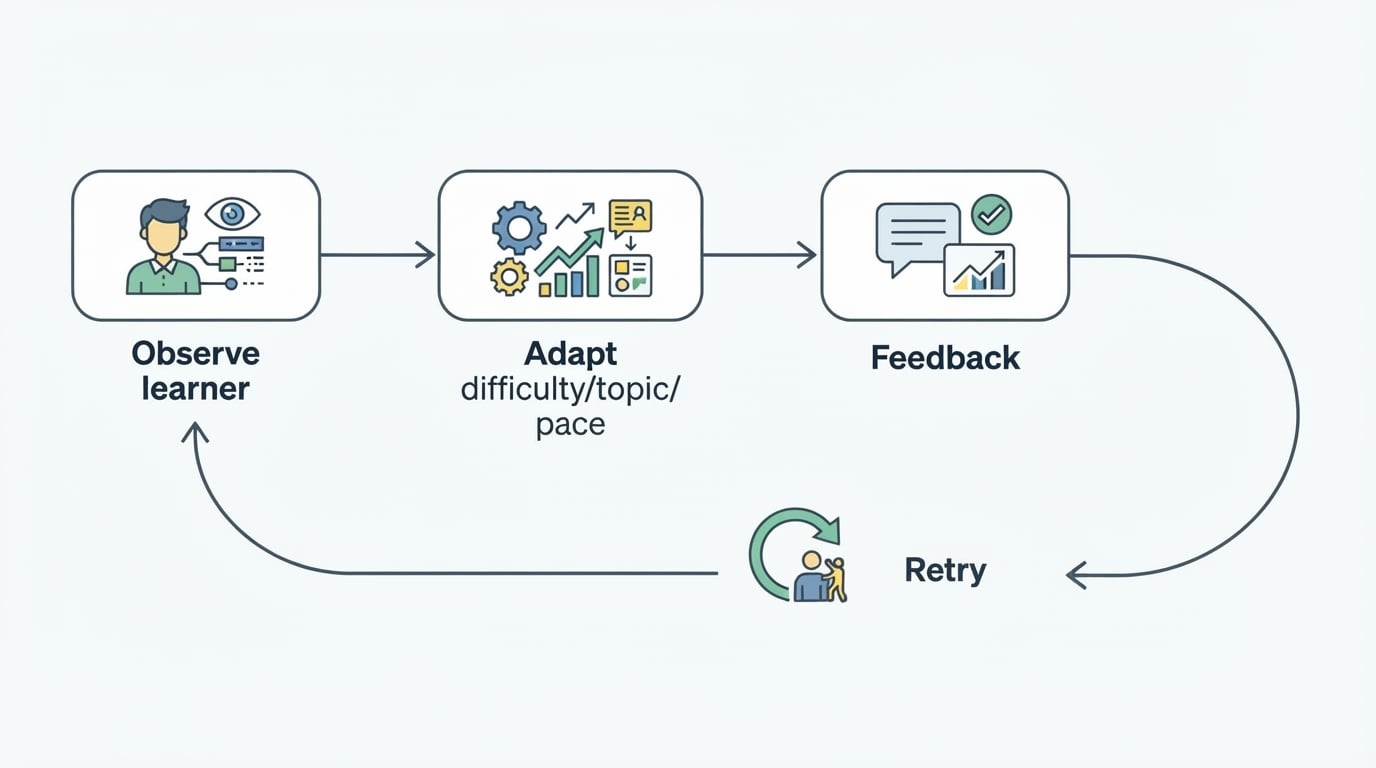
MANA Learn is built around this "3 minutes a day" model. AI generates content matched to each learner's level and progress — no fixed curriculum, you move at your own pace. Per the official site, individualized instruction is offered across CEFR A1 through C2.
Step 4: Bring in listening and speaking early
Reading and writing alone won't make you speak English. **Pull listening and speaking practice in from the start**.
Beginner-friendly listening:
- English-language children's animation (slow, clear speech)
- [BBC Learning English](https://www.bbc.co.uk/learningenglish/) (free, level-graded content)
- YouTube English-learning channels
Speaking practice can start with **talking to yourself**. Introduce yourself in English in the mirror, narrate your day in English — start there.
MANA Learn also offers interactive AI-powered conversation practice. Scenarios like ordering at a restaurant or travel situations let you practice without a human conversation partner.
Step 5: Use apps to make it efficient
Smartphone apps turn dead time into English-learning time. **Commute, lunch break, 5 minutes before bed** — daily gaps become study slots.
What to look for in a beginner app:
- **Level diagnosis**: starts you at content matched to your real level
- **Personalization**: content adapts to your progress
- **Sustaining support**: streaks and reminders to keep the habit
- **Free to use**: zero-cost way to try it first
---
How to Pick an English Learning App
Free vs paid
English-learning apps come in free and paid versions. **For beginners, build the habit with a free app first**.
Paid apps have richer features but typically run $10–30 a month. Spending money before you know whether you'll stick with it is risky.
Features beginners need
| Feature | Priority | Why | |------|--------|------| | Level diagnosis | ★★★ | Start at your actual level | | AI personalization | ★★★ | More efficient than fixed curriculum | | 3-minute sessions | ★★★ | Sustainable | | Pronunciation practice | ★★ | Speaking practice from day one | | Offline mode | ★★ | Independent of connectivity |
About MANA Learn
MANA Learn is a free AI English learning app designed for absolute beginners. Per the official site, it offers AI-personalized instruction from CEFR A1 to C2, optimized for short daily sessions of 3 minutes.
Features:
- Completely free (no paid tier)
- CEFR A1 to C2 coverage
- AI-generated personalized content
- iOS and Android
[Download MANA Learn for free](https://manamana.ai/)
---
Tricks to Keep Going Every Day
The science of habit formation
Per a University College London study (Lally et al., 2010), forming a new habit takes an average of **66 days**. The first two months are the battle for English-learning consistency.
Habit-formation tricks: 1. **Attach to an existing habit**: after brushing teeth, while drinking morning coffee, etc. 2. **Fix a location**: "when I sit in this chair, I study English" 3. **Lower the bar**: commit to "just 3 minutes" — if you want to continue, you can 4. **Track it**: even just an X on a calendar boosts continuation rates
Use gamification
Most English-learning apps build in game elements (streaks, points, badges). Lean into them — studying becomes fun, sustainability follows.
MANA Learn includes gamification features that support English-learning consistency.
---
Frequently Asked Questions
**Q: How many minutes a day do I need for English learning?**
A: 3 minutes minimum still works. **Doing it every day** is what matters. One 2-hour session a week is less effective than 5 minutes a day for memory retention. Once you're settled in, push to 15–30 minutes.
**Q: Which app should an absolute beginner start with?**
A: One that's free and has level diagnosis. MANA Learn is designed for absolute beginners and starts English learning at CEFR A1. Try it free first and see if it fits.
**Q: Can I learn English for free?**
A: Yes — free options are enough for solid English learning. MANA Learn is completely free with no paid tier. BBC Learning English and YouTube learning channels are also free.
**Q: How long before I see results in English learning?**
A: Depends on your target level. With 3–5 minutes a day, **A1 basics in about 3 months**. Daily-conversation level (B1) typically takes 1–2 years of consistent practice. Don't rush — small accumulating progress is the point.
**Q: Does age matter for English learning?**
A: Adults can absolutely acquire English. Pronunciation gets harder past childhood, but vocabulary and grammar comprehension are often **faster for adults**. **You can start English learning at any age**.
---
Summary
You don't need perfect preparation to start learning English. **Start with 3 minutes today.**
Key points:
1. **Set a concrete goal** (travel? work?) 2. **Start at A1 basics** (don't rush) 3. **Keep going 3 minutes a day** (consistency is everything) 4. **Bring in listening and speaking early** 5. **Use a free app to build the habit**
MANA Learn is a free AI English learning app for absolute beginners that you can start with 3 minutes a day. AI-personalized instruction aligned with CEFR helps you build English at your own pace.
Download free and give it 3 minutes today.
[Download MANA Learn for free](https://manamana.ai/)