English Grammar Learning: A Complete Beginner's Guide (2026)
"English grammar sounds hard..." A lot of learners feel this way. The first step is what matters most — get the order right and English reading, writing, and conversation all sit on a solid foundation. This guide walks through concrete steps to learn English grammar from scratch and the practice methods that actually work.
If your native language structure is different from English, this guide also covers the friction points where most learners get stuck, in order, so you know what to start with and how to drill it in.
---
What is English Grammar?
English grammar is the system of rules for using English correctly. The order of words, how verbs change — understanding the *mechanism* of English is where grammar learning begins.
The Core Building Blocks
A few core elements you should pin down first:
- **Parts of speech**: noun, verb, adjective, adverb, preposition. Knowing each one's role is the starting point.
- **Sentence structure (word order)**: English is "Subject + Verb + Object" (SVO) by default.
- **Tenses**: present, past, present perfect — how time is expressed.
- **Auxiliary verbs**: can / will / should — words that modify a verb's meaning.
Don't try to memorize all of them at once. Work through them one at a time.
Where Most Non-Native Speakers Stumble
Some friction points are predictable depending on your native language:
- **Word order**: Many languages put the verb last (SOV) — Japanese, Korean, Turkish, German subordinate clauses. English puts it second (SVO). "I eat an apple" doesn't translate position-for-position to your native pattern. Drilling SVO until it's automatic is more important than memorizing exceptions.
- **Articles (a / the)**: Languages without articles (Japanese, Chinese, Russian, Korean) make this the single hardest area. Start simple: `the` for specific (already known to both speakers), `a` for non-specific (new information).
- **Tense granularity**: English distinguishes "past" from "present perfect" (`I ate` vs `I have eaten`). Many languages collapse both into one form. Don't translate — learn each form's *context* directly.
---
A 3-Step Method for Learning English Grammar
Efficiency comes from sequencing. Here's the order that works:
Step 1: Understand the Basics
Start at the middle school level. You don't need to crack open a heavy grammar reference book on day one.
**How to start:**
- Use a middle-school-level textbook or guide. Get parts of speech and basic sentence structure down.
- Work through "be-verb", "regular verbs", "how to form questions and negatives" — one pattern at a time.
- Read 3–5 example sentences aloud for each grammar point.
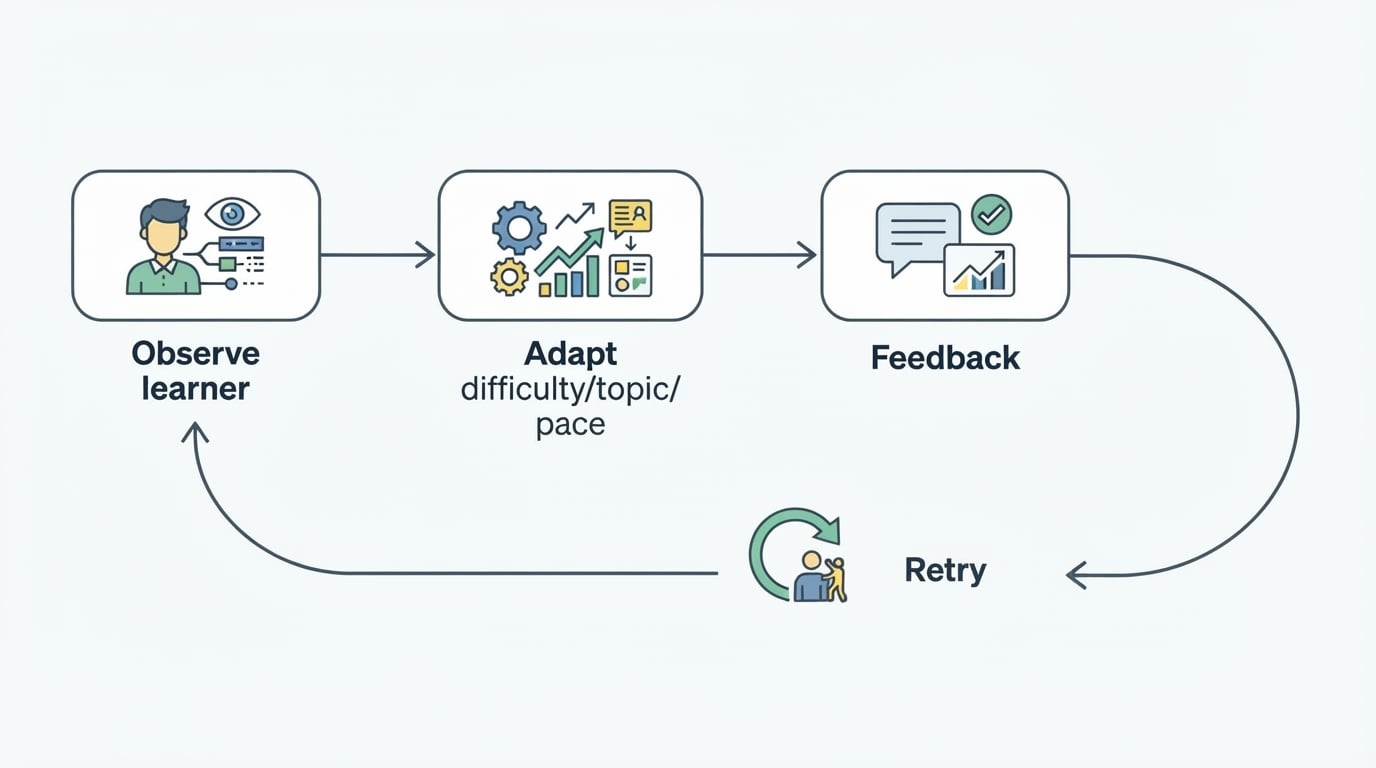
"Master it perfectly before moving on" is the wrong strategy. **"Get the rough idea, move on, come back later"** sticks better. Learn present tense on Monday, past tense Tuesday, review both on the weekend. Iteration beats perfection.
Step 2: Use What You Learn
Memorizing rules isn't enough. The biggest plateau in grammar learning is the gap between "I know the rule" and "I can use the rule."
**Practice methods that work:**
- **Read example sentences aloud**: Speaking the grammar fixes it in your ear and mouth — both reinforce memory.
- **Compose short sentences**: Use the grammar you just learned to write one English sentence about your day. One sentence a day is enough.
- **Fill-in-the-blank exercises**: Use workbooks to check whether you've internalized a pattern.
Step 3: Lock It in Through Real Conversation
Grammar knowledge becomes *usable* English only through use.
**Tips for cementing it in conversation:**
- Try simple English phrases using the grammar you've learned. Stay aware of which pattern you're using.
- Don't fear mistakes. Grammar errors are part of learning, not failure.
- Expose yourself to real English — movies, podcasts, dramas — to see grammar in the wild.
The shortcut is not "perfect grammar then speak". It's **"learn grammar and practice speaking in parallel"**.
---
Tools and Apps for Grammar Practice
What sustains grammar learning is finding tools that fit how you actually study.
How to Pick a Tool
Use these criteria:
- **Right level for you**: Beginners need patient, foundational explanations.
- **Easy to keep up**: Designed for small daily sessions, not multi-hour grinds.
- **Hands-on practice**: Gives you a place to actually *use* the grammar.
Recommended App
After you've got the basics down, the next move is practicing in real conversation scenarios. [MANA Learn](https://manamana.ai) is one option — an AI-driven language app with 3-minute daily sessions that let you practice grammar in actual conversation contexts.
Beyond that, combining a grammar-focused reference book with online conversation services gets you the input/output balance most learners are missing.
---
Frequently Asked Questions
Q1. How long does it take to learn English grammar?
For the basics (middle-school equivalent), 30 minutes a day for 3–6 months gets you through most patterns. "Mastery" varies by person. What matters more than the timeline is *staying consistent*.
Q2. Do I need a grammar book, or is an app enough?
Either works. Grammar books give you systematic structure. Apps are easier to keep up. For beginners, a thin grammar reference + an app for daily practice is the strongest combination.
Q3. Why can't I speak even though I've studied grammar?
Grammar knowledge and *speaking ability* are different skills. Knowing a rule and producing it out loud are not the same neural process. From the moment you learn a new grammar point, pair it with speaking practice. That's the only thing that bridges the gap.
---
Summary
English grammar learning follows a 3-step pattern: **understand the basics → practice with them → lock them in through conversation**. You don't need to chase perfection from day one. Start with middle-school grammar and build incrementally.
Grammar is the foundation of English. With patient, steady study, fluency follows.
If you want to start practicing grammar in real conversation contexts today, check out [MANA Learn](https://manamana.ai). AI-powered 3-minute daily sessions make grammar practical.