7 Ways to Learn English (2026): Free AI Tools That Keep Beginners Going
"I want to study English but have no idea where to start" — a lot of people feel this. For beginners, there are too many textbooks and apps; you get lost before you even begin. So here are 7 hand-picked methods beginners can actually sustain.
The key: **start with 3 minutes a day**. You don't need a big block of time — stacking small daily reps reliably grows your English. And in 2026, free AI-powered tools have matured enough that serious English learning costs nothing.
---
Before You Start
Decide your level and goal
The most common cause of giving up: starting with a vague goal. Two things beginners should nail down first.
**Narrow your purpose:**
- Daily conversation while traveling
- Reading/writing business email
- Watching shows without subtitles
- Working or studying abroad
**Know your CEFR level:** CEFR (Common European Framework of Reference) measures English on six levels, A1–C2. Beginners start at A1 (absolute beginner) and step up gradually.
| Level | Roughly | | --- | --- | | A1 | Self-intro and basic greetings | | A2 | Everyday shopping, directions | | B1 | Explain and handle situations while traveling | | B2 | Communicate with natives at work | | C1 | Follow specialized discussion | | C2 | Near-native command |
If you just "want to be able to speak English," aiming for A2–B1 first is realistic.
---
How to Learn English: 7 Approaches
1. 3-minute daily microlearning with an AI app
The biggest barrier to consistency is **finding time**. A solid one-hour block daily is hard, but 3 minutes fits a commute or lunch break.
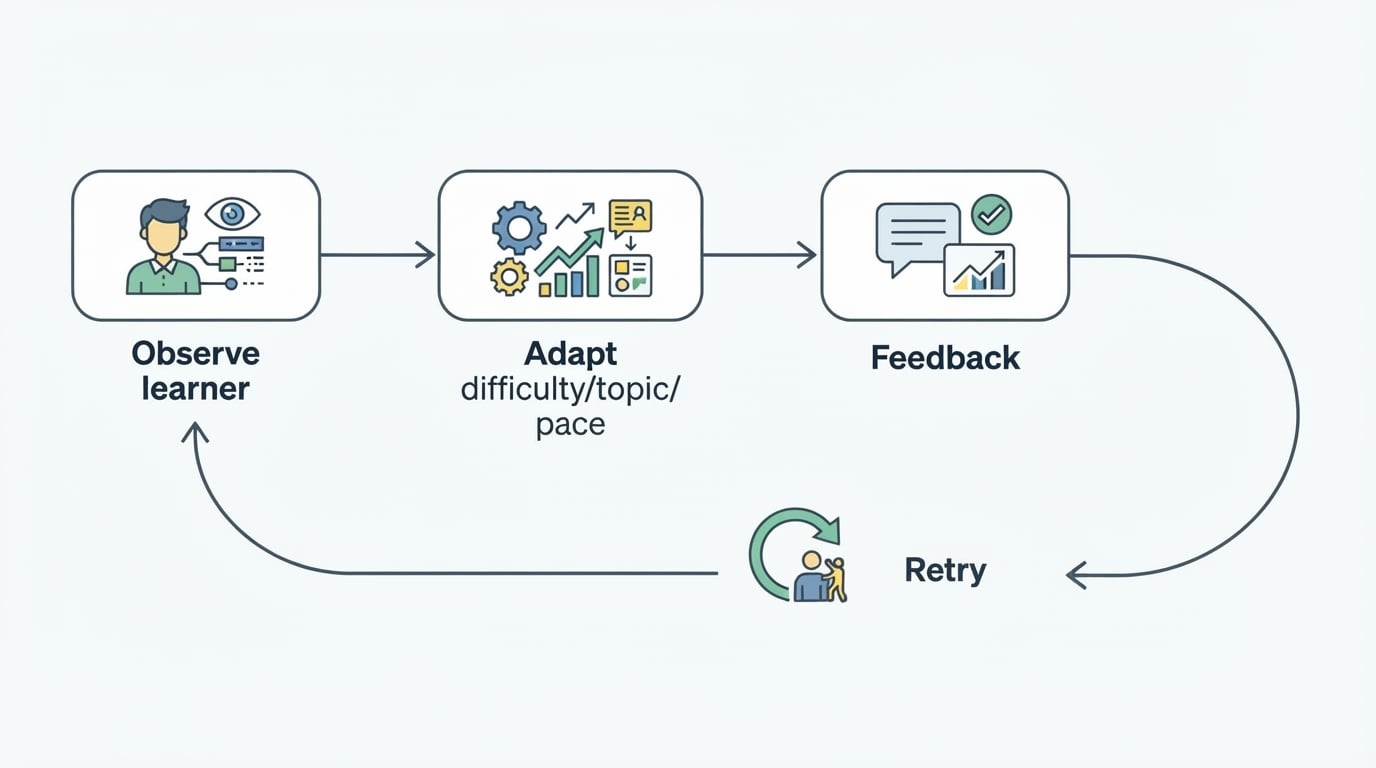
AI-driven language apps auto-generate content matched to your level and progress — good for anyone who burned out on a fixed curriculum.
[MANA Learn](https://manamana.ai), per its official site, is a free app offering CEFR A1–C2 AI-personalized lessons. Built around 3-minute sessions, with gamification to sustain motivation. Fully free — easy for beginners to start.
iOS, Android, and direct APK supported. → [Download MANA Learn and start](https://manamana.ai/download.html)
2. Shadowing for pronunciation + listening at once
Shadowing means repeating a native speaker's audio with a slight delay, mimicking the sentence aloud. Especially effective for self-study — it trains listening and pronunciation simultaneously.
**How to start:**
1. Pick audio slightly easier than your level (BBC Learning English / VOA Learning English) 2. First, mimic aloud while reading the script 3. Once comfortable, do it without the script 4. 5–10 minutes per session, daily
Starting with hard material leads to burnout. Begin with short A1–A2 conversation lines.
3. AI conversation practice for speaking
English doesn't stick without **speaking practice** — but finding a partner is surprisingly hard. AI conversation practice fills the gap.
MANA Learn, per its official site, offers realistic AI conversation practice based on everyday scenarios (ordering food, travel, business meetings) — practice anytime without a human partner. Beginners can repeat freely without the embarrassment hurdle.
4. Extensive reading/listening to grow input
The Input Hypothesis holds that large exposure to slightly-above-your-level English accelerates acquisition. Deliberately increasing reading and listening drives long-term growth.
**Beginner-friendly material:**
- **Reading**: Oxford Bookworms (graded readers), Graded Readers
- **Listening**: BBC Learning English "6 Minute English," VOA Learning English
- **Video**: YouTube "Easy Languages" series
Start with just 10–15 minutes a day of content you enjoy in English. "Enjoy in English" beats "study English" for consistency.
5. Spaced repetition to lock in vocabulary
Vocabulary is the foundation. The most efficient way to grow it in self-study is **spaced repetition** — reviewing words at the optimal moment, just as you're about to forget. Re-reading a word list rarely sticks long-term; use the system instead.
**Spaced repetition pointers:**
- Review new words on short spans (next day, 3 days, 1 week)
- Widen intervals gradually once a word is solid
- Cap new words at 10–20 a day (no cramming)
Flashcard apps like Anki support spaced repetition. AI-type apps can auto-surface reviews at the optimal time.
6. English journaling for daily output
Input alone won't make English "usable." For self-study especially, deliberately creating output matters. Daily output builds fluency — and English journaling is the easiest to sustain.
**How to start (beginner):**
- 3 sentences a day. "Today I ate sushi. It was delicious. I want to try it again." is fine
- Prioritize the writing habit over perfect grammar
- Check what you wrote with DeepL or AI translation, and learn the expressions
Trying to write long entries from day one won't last. Lowering the bar is the secret to consistency.
7. AI translation tools to learn vocab in context
Vocabulary met in context sticks better than words memorized in isolation. When you hit an unknown word while reading, the habit of looking it up on the spot grows your vocabulary naturally.
[MANA Translate](https://manamana.ai/translate.html), per its official site, is a free AI web translation tool covering 15+ languages. No install — works right in the browser, handy for quick word/phrase lookups while learning.
---
3 Reasons English Learning Fails — and Fixes
Reason 1: Goals too high
"Study an hour a day," "master conversation in a month" — overly high goals cause burnout.
**Fix:** decide to do "just 3 minutes." Unless a day is physically impossible, 3 minutes is sustainable. Increase time after the habit forms.
Reason 2: Progress is invisible
English ability only shifts on a months scale, so the sense of effort paying off fades.
**Fix:** check your CEFR level periodically. Take an online CEFR test (Cambridge English etc.) every 3–6 months to confirm objective progress.
Reason 3: No gamification or habit structure
Willpower alone rarely sustains daily practice. Game elements (streaks, badges, rankings) and behavior design ("pair it with the morning routine") help.
---
Beginner English Roadmap (3 months – 1 year)
| Period | Target level | Focus | Daily | | --- | --- | --- | --- | | 1–3 months | A1 | Pronunciation, 500 core words, greetings | 3–10 min | | 4–6 months | A2 | Listening, short conversation | 10–20 min | | 7–12 months | aim B1 | Speaking, writing practice | 20–30 min |
The top priority in the first 3 months is building a "don't-quit" habit. A little daily beats a few hours crammed on weekends.
---
FAQ
**Q. Can I learn English on my own?** A. Yes. Reading, writing, and listening suit self-study well. Speaking needs deliberate output, but AI conversation apps cover that.
**Q. How many hours a day until I can speak English?** A. Research suggests 1,000–2,000 hours of input, but even 15–30 minutes daily reaches conversational level in 2–3 years. Quality and consistency matter more than raw hours.
**Q. Can I learn English seriously for free?** A. Yes. Combining YouTube (BBC Learning English etc.), free AI learning apps, and open flashcard tools enables systematic learning at zero cost.
**Q. Which app should a beginner start with?** A. An AI-adaptive free app starting from CEFR A1 is ideal. Pick one with 3-minute sessions for easy consistency.
---
Summary: Start Today
Seven ways to learn English:
1. 3-minute daily microlearning with an AI app 2. Shadowing for listening + pronunciation 3. AI conversation practice for speaking 4. Extensive reading/listening for input 5. Spaced repetition for vocabulary 6. English journaling for output habit 7. AI translation tools for vocab in context
What matters is "starting today" over "finding the perfect method." The first step can be tiny. 3 minutes a day — make English a habit starting today.
MANA Learn is a fully free AI language learning app. Per its official site, it starts from CEFR A1 and is built to sustain through busy days. Download and try it.
[Download on App Store / Google Play](https://manamana.ai/download.html)