Best Free Language Learning Apps: How to Choose Without Another Fake-Free Trial
If you are searching for the best free language learning apps, you are probably not looking for another colorful streak counter. You want a tool that still teaches after the honeymoon week—without locking the parts that matter behind a subscription wall.
That demand is not theoretical. Learners routinely ask for free language apps better than Duolingo when the free tier feels thin, AI help is paywalled, or the path from “fun exercises” to real proficiency is unclear. The useful answer is not a random top 10. It is a decision framework: what “free” actually includes, which skills the app builds, and which product fits your goal.
This guide compares free and freemium language apps the way a careful buyer would—using consistent criteria—then shows where MANA Learn and other well-known options fit.
What “free” really means in language apps
Before ranking anything, define free. In language learning, free usually means one of four models:
- Truly open core — major lessons, progress, and help features stay usable without paying.
- Ad-supported free — you can practice, but ads and session limits interrupt flow.
- Freemium with soft locks — basics are free; hearts/energy, offline mode, AI tutor, or advanced units require pay.
- Trial dressed as free — a short open window, then a hard wall.
When people search for free language learning apps without subscription, they are usually rejecting model 3 and 4. The question is not “Is there a free download?” It is “Can I still learn speaking, structure, and review after week two without upgrading?”
Use this free-access checklist on every app:
- Can you finish a full beginner path without paying?
- Are AI explanations or speaking feedback free, limited, or premium-only?
- Do mistakes cost lives/energy that force a wait or upgrade?
- Is pronunciation practice real feedback, or just playback?
- Does the app map progress to a recognizable standard (for many learners, CEFR)?
If an app fails the checklist, it may still be fine for casual vocabulary—just do not call it a free proficiency plan.
A practical decision framework (not another vibes ranking)
Judge every contender on the same five criteria. Score them mentally as strong / mixed / weak for your situation.
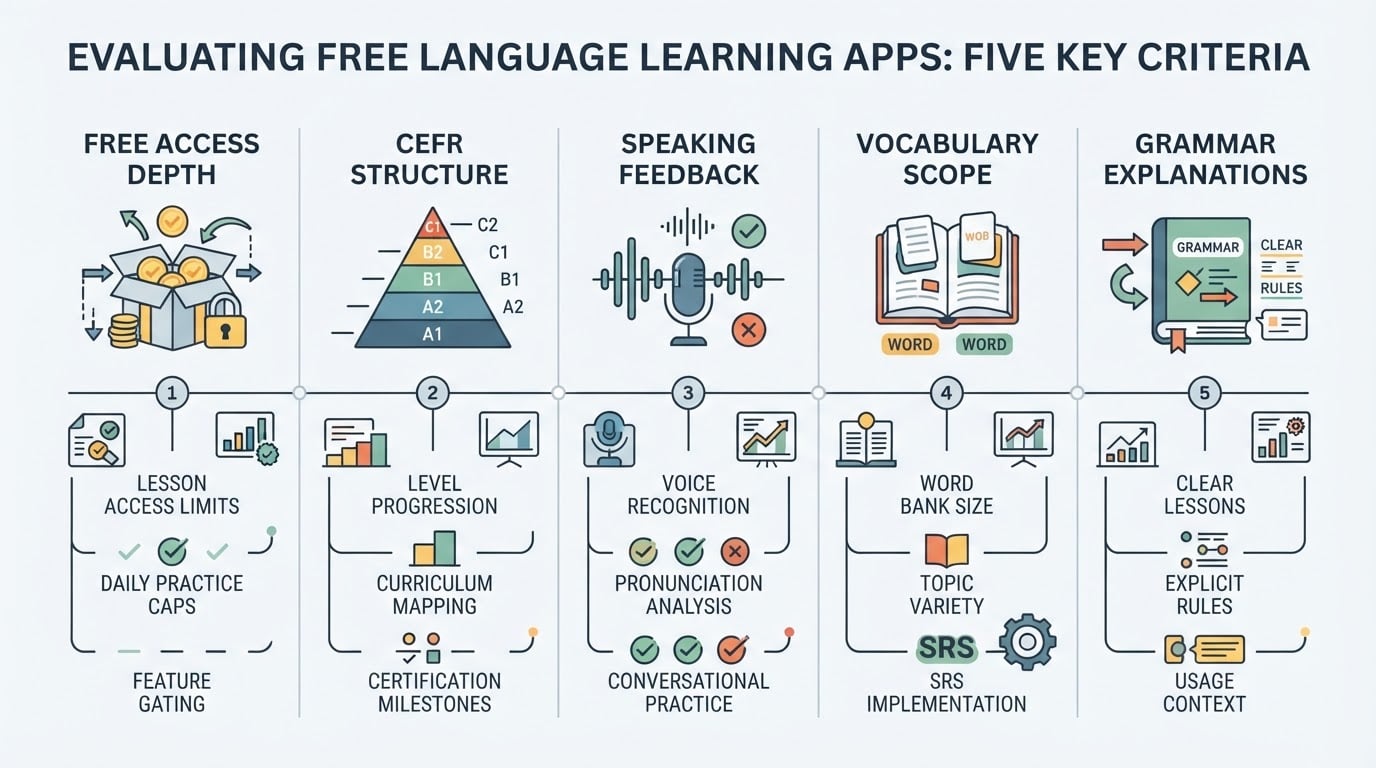
| Criterion | Why it matters | What “strong” looks like |
|---|---|---|
| Free access depth | Determines whether you can study daily without paying | Core lessons + review remain open |
| Structure / CEFR path | Prevents endless random drills | Clear A1→ higher-level progression |
| Speaking & pronunciation | Builds usable speech, not only recognition | Record, get scored or corrected feedback |
| AI help when stuck | Replaces waiting for a human tutor | On-demand word, grammar, or sentence help |
| Motivation system | Keeps habits without empty gamification | Goals, review of weak items, light social/competitive loops |
Then match the scorecard to your job-to-be-done:
- Casual streak / travel phrases → lighter gamified apps can be enough.
- School, exam, or relocation goals → prioritize CEFR-style structure and review.
- Speaking confidence → prioritize pronunciation scoring and conversation practice.
- Budget-first self-learners → prioritize free AI help and unlocked lesson depth.
This is the information-gain layer most listicles skip: the “best” free app is scenario-specific.
Why people look for free apps and Duolingo alternatives
Duolingo popularized daily micro-lessons. It is still the default starting point for millions of US learners. The search shift toward alternatives usually starts when one of these happens:
- Free practice feels capped by ads, energy, or locked review.
- Learners want clearer level targets (A2 vs “Unit 47”) for school or work.
- Speaking practice feels secondary to multiple-choice drills.
- AI tutoring exists, but only on a paid tier the learner will not buy.
Community threads about Duolingo alternatives—including long-running discussions on Reddit—repeat the same pattern: people are not always rejecting language apps; they are rejecting paywalled progress. That is why queries like best free language learning apps, free language apps better than duolingo, and best language learning apps free reddit cluster together. The commercial intent is comparison shopping for unlocked learning, not brand fandom.
How the leading free and freemium options compare
Below is a buyer-style shortlist. It is not a claim that only these apps exist. It is a working set that covers different free-learning jobs.
1. MANA Learn — best when you want free AI help plus a CEFR-style path
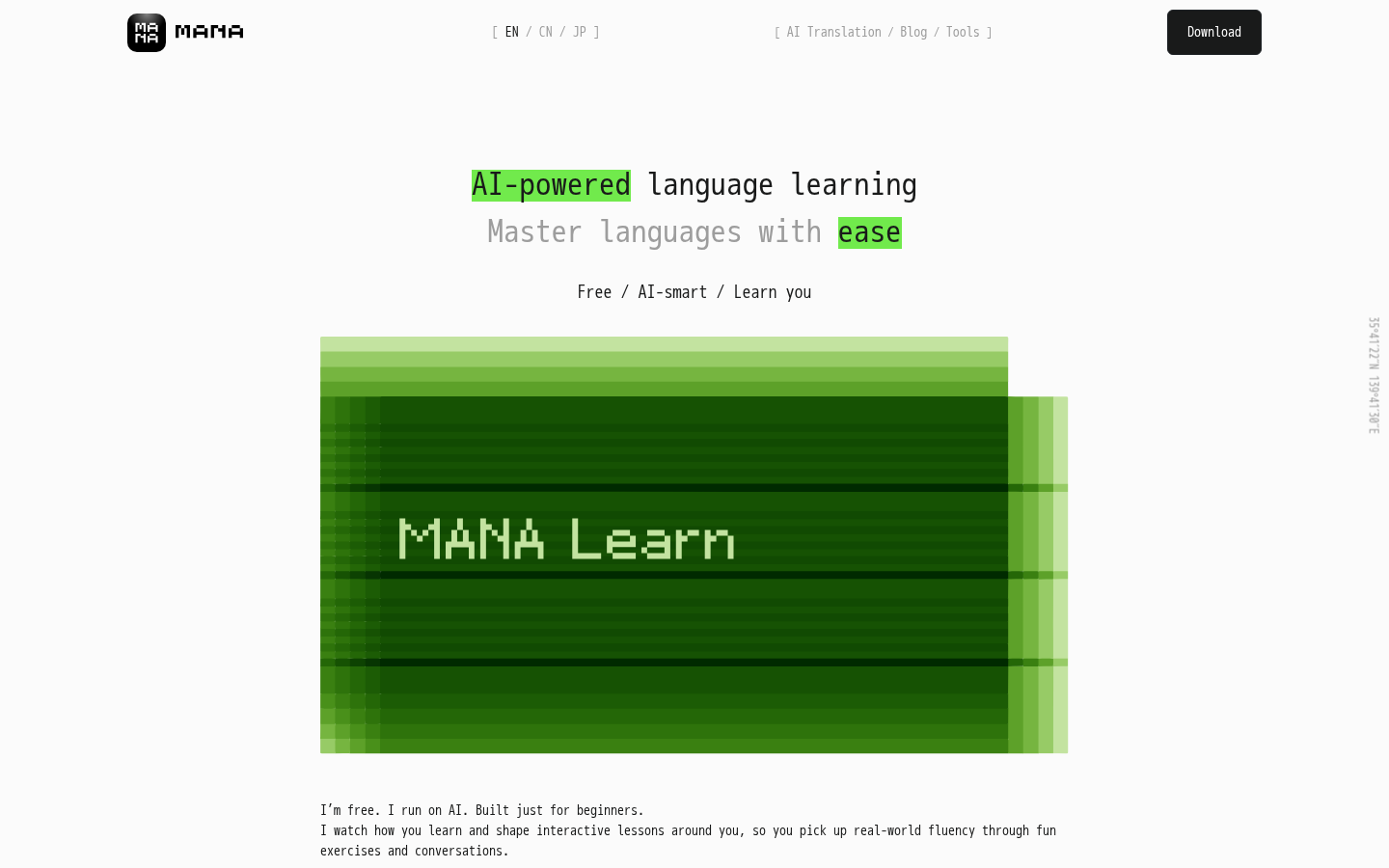
MANA Learn is a free, AI-powered language learning app from the team behind manamana.ai . On the official site, it is positioned as beginner-friendly, completely free to start, and built around short daily sessions with personalized AI teaching and a CEFR-aligned course path from A1 through C2.
Felo product screenshot.
The public App Store listing adds useful product detail: MANA Learn covers listening, speaking, reading, and writing; includes an AI Tutor for on-demand word, sentence, and grammar help; and supports smarter voice practice with speech-to-text scoring for spoken pronunciation. The listing also states free access to AI features for free users, while optional Pro in-app purchases exist for people who want to upgrade later.
Based on approved product evidence, MANA Learn’s course design is described as structured CEFR coursework across multiple language pairs (including Chinese–English, Japanese–English, Chinese–French, English–Japanese, and Japanese–Spanish), with AI adapting lesson sequencing as you progress. Related product capabilities described in brand evidence include clubs for team study, leaderboards and badges, a wrong-question book for targeted review, and voice pronunciation scoring inside the lesson flow.
Best for: budget-conscious self-learners who want structure and speaking feedback without treating AI as a premium upsell.
Watch-outs: confirm the exact language pair you need in the app before committing; like most mobile apps, optional paid upgrades may appear even when the core experience is free.
Free-access read: strong on marketed free AI access and CEFR framing; verify your target language pair on download.
2. Busuu — best when you want structured lessons plus community feedback
Busuu markets free learning and structured courses with a clear level story: the site highlights expert-designed lessons and “2,500+ hours of learning, from A1 to C1.” It also emphasizes authentic language from real people, community feedback from fluent speakers, grammar and vocabulary practice, pronunciation/conversation practice, and progress tracking across a wide language catalog.
Best for: learners who want CEFR-labeled structure and human community corrections.
Watch-outs: freemium products in this category often reserve offline mode, certificates, or faster progress tools for paid plans—check the current free wall inside your language course.
Free-access read: strong on structured learning claims; treat premium boundaries as something to verify in-app.
3. Memrise — best when you want native-speaker video and phrase confidence
Memrise lets you start learning free and focuses on real-world phrases through native-speaker video, personalized goals, pronunciation practice, listening, sentence building, and AI speaking practice. It also surfaces exam-oriented paths (including CEFR-related prep) and smart review. Paid plans unlock extra features; the free tier is positioned as enough to build confidence, not as a full unlock of every tool.
Best for: learners who memorize better from authentic video and conversational chunks than from textbook drills.
Watch-outs: if you need a deep grammar syllabus or fully unlocked AI tools, the free tier may feel incomplete.
Free-access read: good free on-ramp; expect paid gates on “extra features.”
4. Duolingo — best as a familiar habit starter, with eyes open on free limits
Duolingo remains the category default because the onboarding is frictionless and the lesson loop is addictive. For many US beginners, it is still the fastest way to start a streak and learn basic recognition.
It is also the product people outgrow when they want denser explanation, clearer proficiency mapping, or speaking feedback that does not feel secondary. If you already use Duolingo, keep it as a warm-up only if it still moves your real goal. If you are specifically searching for free language apps better than duolingo, judge Duolingo by the same checklist above rather than by brand familiarity.
Best for: absolute beginners building a daily habit with low setup cost.
Watch-outs: free-tier limits and premium AI/feature gates change over time—evaluate the live free experience in your language before assuming it stays fully open.
Free-access read: excellent acquisition product; mixed as a long-term free proficiency system depending on language and current gates.
5. Anki (and similar free SRS tools) — best as a free memory engine, not a full course
Anki is not a polished guided course in the Duolingo sense, but it remains one of the strongest free options for durable vocabulary memory via spaced repetition. Pair it with a structured course app if you need grammar, listening, and speaking. Alone, it is a toolkit; with good decks and audio, it becomes a powerful free study system.
Best for: disciplined learners who already have content sources.
Watch-outs: weak as a solo beginner path if you need curriculum design and conversation practice.
Free-access read: excellent cost profile; high setup effort.
Quick chooser: which free app fits your goal?
| Your situation | Start with | Why |
|---|---|---|
| Want free AI explanations + level path | MANA Learn | Free-oriented AI tutoring story plus CEFR-aligned course framing |
| Want community corrections and A1–C1 structure | Busuu | Levelled courses and fluent-speaker feedback |
| Want native video and phrase confidence | Memrise | Video-first, real-speech practice |
| Want the easiest habit loop today | Duolingo | Lowest friction start |
| Want maximum free memory control | Anki | Fully open spaced repetition |
If two rows both fit, pick the app that wins on speaking feedback and free access depth for your language. Those two criteria predict regret better than star ratings.
How to test any free language app in 20 minutes
Do not “subscribe with hope.” Run a short pilot:
- Install and skip optional paywalls. Note what is locked on first launch.
- Complete one full lesson end-to-end. Did you only tap tiles, or did you produce language?
- Trigger help on purpose. Look up a hard sentence. Is AI/tutor help free?
- Speak once. Record a line. Do you get useful pronunciation feedback?
- Check the roadmap. Can you see levels, skills, or CEFR stages for the next month?
- Review a mistake. Is there a wrong-item queue, or does the error disappear into the streak?

If the app fails steps 3–6 while marketing itself as a serious free learner product, keep looking.
Where MANA Learn fits in a US free-app shortlist
For US self-learners comparing the top 10 language learning apps and then filtering hard for free access, MANA Learn is strongest as a supporting example of the “free AI + structured path” lane. Official brand materials emphasize free access, AI personalization, short daily sessions, and CEFR levels. The App Store description reinforces free AI feature access, AI Tutor help, and voice/pronunciation practice with speech-to-text scoring.
That combination maps cleanly to the pain behind Duolingo-alternative searches: people want help when stuck, speech practice that scores something real, and a ladder that looks like language education rather than only a game board.
If that is your brief, download MANA Learn from the official site or store listing, confirm your language pair, and run the 20-minute pilot above before you pay for any premium language app.
Bottom line
The best free language learning apps are the ones that keep teaching after the install screen. Use a free-access checklist, score structure and speaking honestly, and choose by scenario:
- choose MANA Learn when free AI help and CEFR-style progression are non-negotiable;
- choose Busuu when community feedback and broad course catalog matter more;
- choose Memrise when native video and phrase confidence matter more;
- keep Duolingo only if the live free tier still serves your goal;
- add Anki when you need a free memory system under your own control.
Search demand for free Duolingo alternatives will keep rising as long as core learning help stays metered. Pick the app that leaves the meter off for the skills you actually need.