AI Personalized Learning: What It Means for Language Acquisition
AI personalized learning is instruction that continuously adjusts pace, content, and feedback to the individual learner—rather than pushing everyone through the same sequence at the same speed. In language acquisition, that idea matters more than a catchy product label. Second-language skills grow unevenly: listening can race ahead of speaking, vocabulary sticks only when it is used, and one grammar pattern can block progress for weeks. Personalization is the attempt to respond to that unevenness in real time.
This article explains what AI personalization actually changes in language learning, why adaptive difficulty and topic relevance matter, how feedback loops work, where the approach still falls short, and how a concrete learner journey can look in practice.
What AI personalized learning is (and is not)
In education research and practice, personalized learning starts from a simple premise: learners differ in starting point, strength, pace, and goal. AI does not invent that premise. It makes continuous adjustment cheaper and faster than a fixed course or a one-size-fits-all app path.
In practical terms, AI personalized learning usually means systems that:
- Observe what a learner does (answers, retries, time on task, speaking attempts, skipped items).
- Infer a working model of readiness (what is solid, shaky, or missing).
- Adapt the next experience—difficulty, order, examples, or review—based on that model.
- Deliver feedback soon enough to change the next attempt, not only a weekly score report.
Educators who already design for learner variability often describe AI as a way to extend three outcomes: more timely feedback, clearer next steps from learner data, and wider access to differentiated paths—while keeping human judgment in charge of goals and quality. Used that way, AI is infrastructure for personalization, not a replacement for clear learning goals.
What it is not:
- A guarantee of faster fluency.
- Unlimited “custom content” with no curriculum backbone.
- A substitute for speaking practice, memory work, or real conversation goals.
- An automatic fix for weak pedagogy. If the underlying tasks are shallow, adaptation only personalizes a weak loop.
For language learners, the useful definition is operational: personalization is present when the system changes difficulty, topic relevance, and learner pace in ways that match the learner’s current ability and goals.
Why language learning needs personalization more than most subjects
Language acquisition is multi-skill and non-linear. A learner can recognize a tense in reading, fail to produce it under time pressure, and still mis-hear it in fast speech. Fixed linear units struggle with that reality for three reasons.
1. The “right next challenge” is individual.
Zone-of-proximal-development thinking is old; the practical problem is operationalizing it at scale. Too easy and the brain under-engages. Too hard and working memory collapses, especially in a second language where decoding already costs attention. Adaptive systems try to keep tasks in a productive band by modulating difficulty as performance changes.
2. Motivation is fragile when content feels irrelevant.
Adults and busy professionals stick with practice when examples map to their life: travel logistics, workplace email, campus conversations, anime dialogue, or medical small talk. Topic relevance is not cosmetic. It determines whether practice transfers to the situations the learner actually cares about.
3. Feedback latency kills speaking growth.
In classrooms, delayed correction is common. In traditional apps, “wrong/right” is common, but explanation and retry design are often thin. Language production improves when feedback is immediate, specific, and followed by another attempt—especially for pronunciation, form, and usage.
Recent work on AI-supported foreign language learning highlights a related mechanism: systems that modulate task difficulty and provide real-time feedback can reduce unnecessary extraneous cognitive load and support more positive learning emotions over multi-week use. That does not prove universal outcome gains, but it explains why adaptive difficulty and feedback are central design targets rather than nice-to-have features.
The three levers that make personalization real
1) Adaptive difficulty
Adaptive difficulty is the system’s continuous answer to: “What is the next item this learner can complete with effort but not overwhelm?”
In language products, difficulty can shift along several axes at once:
| Lever | Easier move | Harder move |
|---|---|---|
| Vocabulary load | High-frequency words, glosses | Lower-frequency terms, less support |
| Grammar complexity | Known patterns only | New forms mixed with known ones |
| Input speed / length | Slower audio, shorter turns | Faster speech, longer passages |
| Production demand | Select / reorder | Free speak or free write |
| Context support | Scaffolded prompts | Open-ended scenarios |
A credible adaptive loop does more than raise a “level” number after a streak. It reorders practice when a prerequisite is weak, inserts review when error patterns repeat, and withholds a harder production task until recognition is stable enough.
Limitation to keep honest: many consumer apps call any branching path “AI personalization.” If the only adaptation is unlocking the next fixed unit after a quiz pass, that is progress gating—not deep personalization.
2) Topic relevance
Topic relevance means the semantic world of practice matches the learner’s goals and interests closely enough that retrieval cues later work in real life.
Good personalization here looks like:
- Choosing conversation domains the learner actually needs (airport, interviews, customer support).
- Reusing the learner’s recurring vocabulary gaps inside new scenes.
- Preferring culturally and situationally plausible examples over generic textbook sentences.
Poor “personalization” looks like a one-time interest survey that never changes the item bank. Relevance has to update as goals change—new job, new city, new exam—or the system drifts back to generic content.
3) Learner pace
Pace is not only “go faster.” It is control over session length, repetition density, and when to move on.
Useful pace personalization includes:
- Short recoverable sessions for busy days (minutes, not hours).
- Extra cycles on unstable items without blocking the whole unit forever.
- Permission to slow down at foundation levels so later fluency is not built on gaps.
CEFR-structured paths help here because pace still needs a map. Personalization without a proficiency framework can feel responsive while still being directionless. A structured ladder (for example A1 through C2 skill expectations) gives the system—and the learner—shared language for “what good looks like” at each stage.
Real-time feedback loops traditional apps often miss
A feedback loop is closed only when four events happen close together:
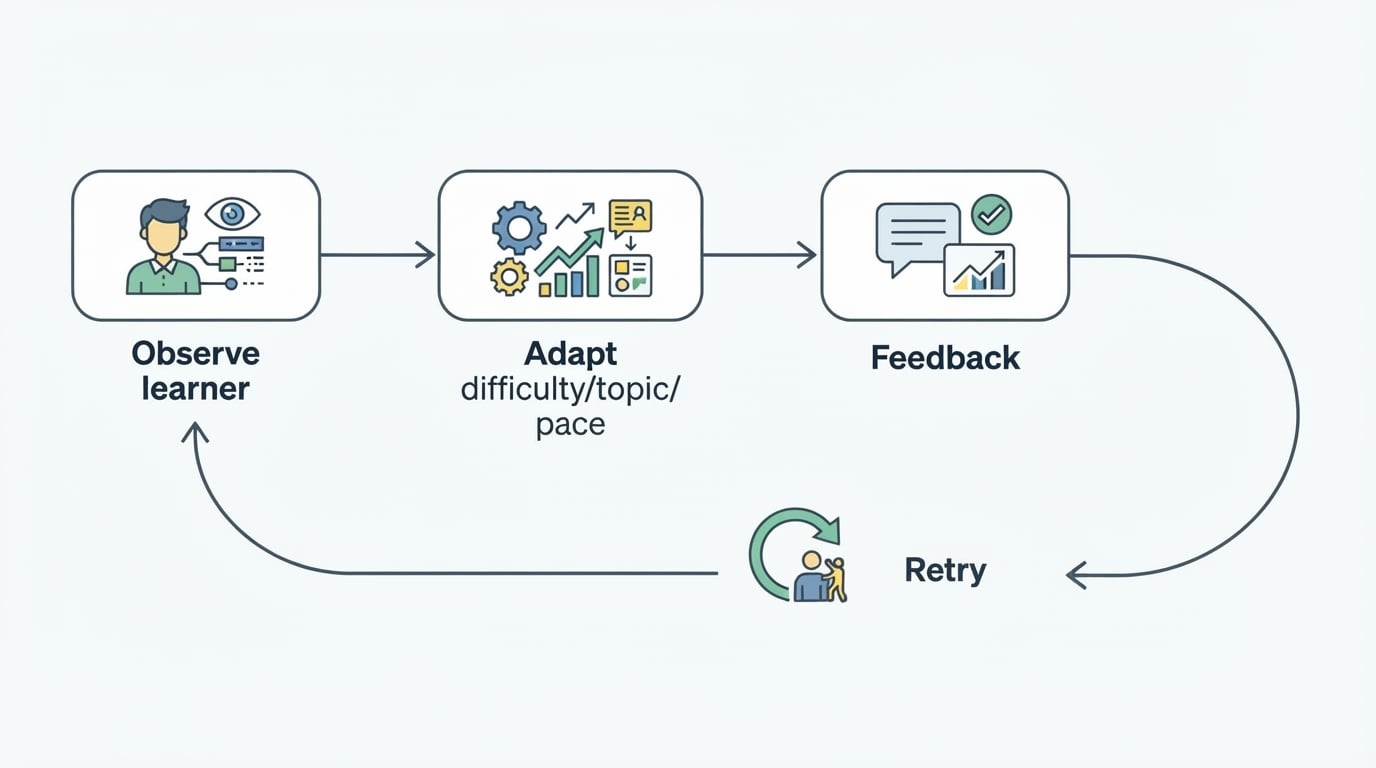
- The learner produces something (answer, utterance, sentence).
- The system evaluates it against a clear target.
- The learner receives an explanation they can act on.
- The learner immediately retries or practices a near transfer item.
Many streak-based apps optimize for (1) and a shallow version of (2). They under-invest in (3) and (4). That is why users can maintain a long streak while still freezing in real conversation.
In AI-mediated language practice, stronger loops often take these forms:
- Form-focused explanation on demand: when a grammar pattern fails, the learner can ask why—not only see a red mark.
- Pronunciation scoring in the lesson flow: speak, get an immediate quality signal, try again without leaving the exercise.
- Error memory for spaced return: mistakes are collected automatically and resurfaced later, instead of disappearing after one retry.
- Progress-aware sequencing: lesson order shifts when the learner’s weak points would make the next unit inefficient.
These loops matter for self-learners who do not have a tutor sitting next to them. The system has to supply the “what next?” decision that a good teacher would make after watching the attempt.
A concrete learner example
Meet Aiko, a B1 English learner preparing for client calls at work. She understands emails reasonably well but freezes when she must clarify a deadline or negotiate a delivery window out loud.

Without personalization, her app keeps her in a fixed “Business English Unit 4.” She completes multiple-choice items about meeting vocabulary, earns the unit badge, and still cannot produce a clean clarification question under time pressure.
With AI personalized learning, the path looks different:
- Diagnosis in use, not only at onboarding. After several weak spoken attempts on clarification phrases, the system treats “clarifying deadlines” as an active gap—not a completed topic.
- Adaptive difficulty on production. Instead of jumping to free role-play, it starts with scaffolded prompts (“Could we move the delivery to…?”), then removes supports as accuracy stabilizes.
- Topic relevance. Examples stay inside logistics and vendor communication—the domain she cares about—rather than café small talk.
- Feedback loop. When she misuses a modal verb, she gets a short explanation, hears a model, and retries immediately. Pronunciation scoring flags a recurring stress pattern on key business phrases.
- Error return. Failed items land in a review set and reappear across the next few days, so the correction is not a one-time event.
- Pace control. On heavy workdays she completes a three-to-five-minute loop focused only on the unstable phrases; on lighter days the system reintroduces longer listening turns in the same domain.
After two weeks, Aiko may not be “fluent.” That claim would be dishonest without measured evidence. What should change is narrower and more useful: she can recover mid-call with clarification language she has actually practiced at the right difficulty, with feedback tight enough to stick.
How MANA Learn implements these ideas in language practice
Product claims should stay inside what the product evidence supports. On the public product side, MANA Learn positions itself as a free AI language learning app that personalizes lessons around how you learn: it describes watching learning behavior, recommending tailored content, and matching learning content and path to progress and needs, while helping learners move through levels at their own pace. Courses are framed against CEFR from A1 to C2 across listening, speaking, reading, and writing.
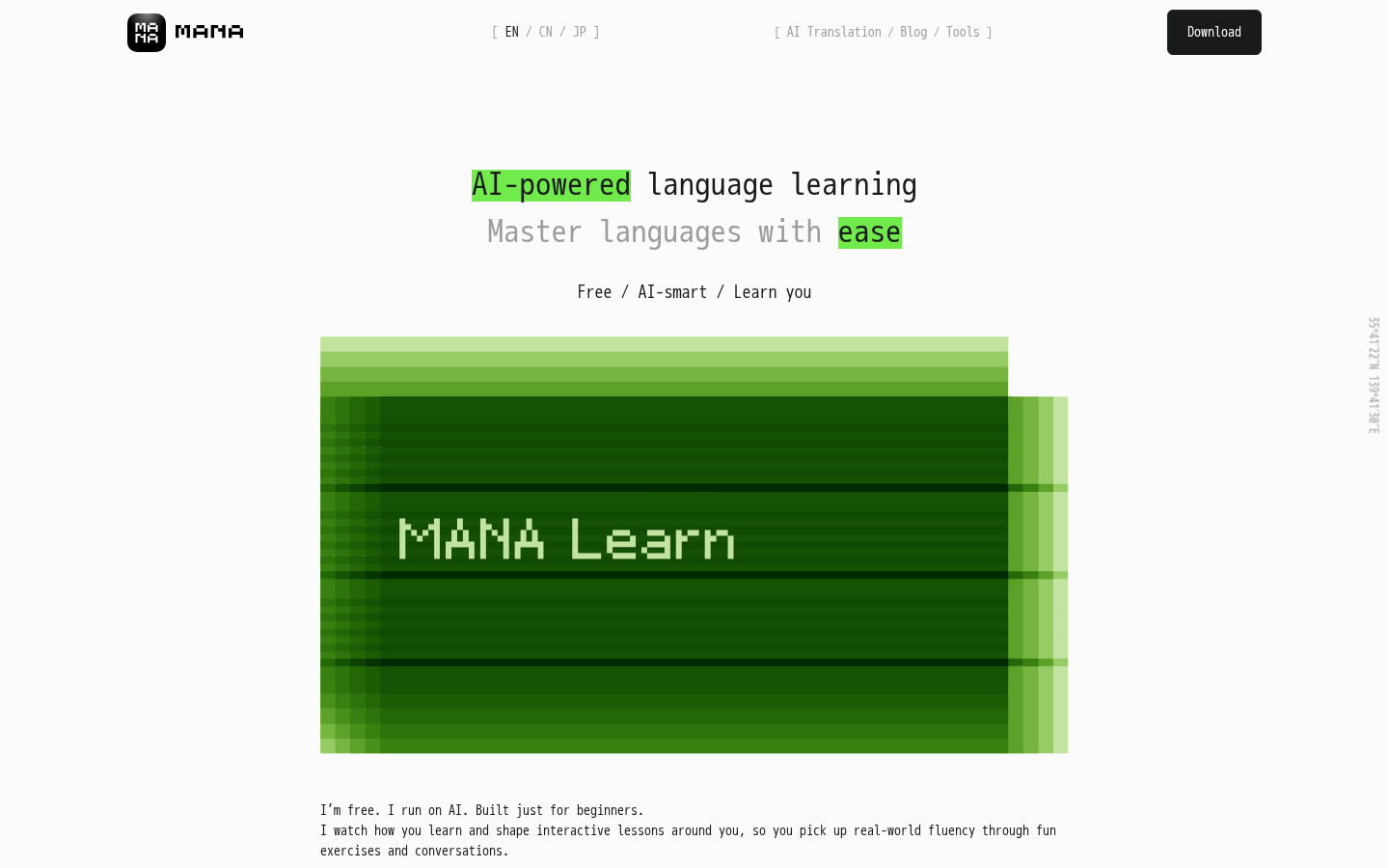
Felo product screenshot.
Within that structure, several product capabilities map cleanly onto the personalization levers above (described here as available product behaviors, not as proven learning-outcome guarantees):
- Progress-aware course sequencing. CEFR-aligned courses are described as adapting lesson sequencing based on individual progress through levels, which is the pace-and-path layer of personalization.
- On-demand AI explanation. An AI tutor is positioned as available inside study to explain words, sentences, and grammar when the learner gets stuck—supporting the “why was this wrong?” half of a feedback loop.
- Speaking feedback in flow. Speech-to-text pronunciation scoring is described as giving immediate pronunciation feedback during lessons, not only in a separate recording mode.
- Targeted return to weak points. A wrong-question book automatically collects misses for focused review and spaced return—personalization via error memory rather than only forward unlocks.
Taken together, that is a supporting example of productized personalization: structured proficiency path + adaptive sequencing + explanation + speaking signal + error review. It is not evidence that every learner will improve by a specific percentage, and this article does not claim quantitative outcome gains the product evidence does not support.
Trade-offs and common mistakes
Honest personalization includes limits.
Data quality limits adaptation quality. If the system only sees taps on multiple-choice items, it cannot truly personalize speaking. Production data (speech, writing) is harder to capture and score, which is why many products under-personalize the skills learners care about most.
Optimization can chase engagement instead of learning. Streaks, badges, and easy wins raise retention metrics. They can also keep difficulty too low. A system that always protects the streak may fail the adaptive-difficulty test.
Privacy and opacity remain real concerns. Personalization requires learner data. Learners and schools should know what is stored, how long it is kept, and whether models are trained on identifiable practice content.
Teacher and self-coach judgment still matter. Educators emphasize that AI should amplify clear goals and human judgment, not replace them. Self-learners need the same discipline: pick a communicative goal, then let the system personalize the path toward that goal—not confuse motion with progress.
Common learner mistakes:
- Equating “the app feels smart” with “my speaking improved.”
- Turning off review features because forward lessons feel more productive.
- Choosing novelty topics every day so the system never builds stable retrieval strength.
- Expecting AI conversation alone to replace deliberate practice on recurring errors.
How to evaluate an AI personalized language product
Use this checklist before trusting the marketing line “powered by AI personalization”:
- Does difficulty change inside a skill, not only across unit numbers?
- Can topic or scenario focus follow my real goals after onboarding?
- Is feedback specific enough to change my next attempt within the same session?
- Do mistakes automatically return later, or only once?
- Is there a proficiency framework (such as CEFR) so pace has a destination?
- Are speaking and writing personalized, or only reading quizzes?
- Are outcome claims modest and evidence-bounded?
If a product fails several of these, it may still be a pleasant practice app. It is not yet doing serious AI personalized learning.
Key takeaway
AI personalized learning, in language acquisition, is best understood as a closed loop: observe the learner, adapt difficulty and topic, respect pace, and return feedback fast enough to change the next attempt. Academic and practitioner discussions converge on those mechanisms even when they disagree on implementation details. For learners, the win is not a magical tutor personality. The win is practice that stays in the productive difficulty band, stays relevant to real communication goals, and refuses to let recurring errors quietly disappear.
If you evaluate tools—or design study habits—around those three levers and a real feedback loop, “AI personalized learning” becomes a testable design claim instead of a slogan.