AI in Education: Why Language Learning Is Moving Beyond Streaks
For most of the last decade, AI in education has been marketed as a promise of personalization. In language learning, that promise often arrived as streaks, hearts, leaderboards, and bite-sized drills. Those systems were useful. They made daily practice easier to start. They also quietly trained millions of learners to equate progress with points.
That era is ending.
The next chapter of AI in education is less about keeping people in an app and more about giving them practice they could rarely get before: adaptive speaking, on-demand explanation, and tutoring that responds to the learner in front of it. The shift matters because language is not a trivia subject. It is a performance skill. You do not become fluent by recognizing the right multiple-choice answer. You become fluent by producing language under pressure, recovering from mistakes, and trying again while the conversation is still alive.
The real bottleneck was never content
Traditional language apps solved distribution. They put vocabulary decks, grammar notes, and listening clips into every pocket. What they could not scale was the scarce resource that actually changes speaking ability: a patient interlocutor.
A human tutor can notice that you freeze on past-tense questions, simplify a prompt, reframe the task, and push you one notch further. That kind of contingent feedback is expensive. Classrooms ration it. Apps often replaced it with game loops.
This is why so many learners plateau. They can complete lessons. They can keep a streak alive. Then they meet a real conversation and discover that recognition is not production. The missing piece was not more content. It was more chances to speak, fail safely, and get useful feedback immediately.
AI changes the economics of that missing piece. When a system can listen, respond, explain, and adjust difficulty in the moment, speaking practice no longer depends on finding another person at the right level, in the right language, at the right hour.
From gamification to conversational tutoring
Gamification was a rational product decision. If an app cannot provide rich interaction, it can still reward consistency. Badges and leaderboards reduce dropout by making practice feel lighter. That still has value. Motivation is part of learning design.
But motivation without transferable skill is a trap. A learner who opens an app every day may still avoid the moments that build competence: unrehearsed speech, repair strategies, listening while planning a reply, and negotiating meaning when the first sentence fails.
Conversational AI tutors flip the center of gravity. Instead of asking, "How do we keep the user coming back?" the better question becomes, "How do we create practice that looks more like the real task?"
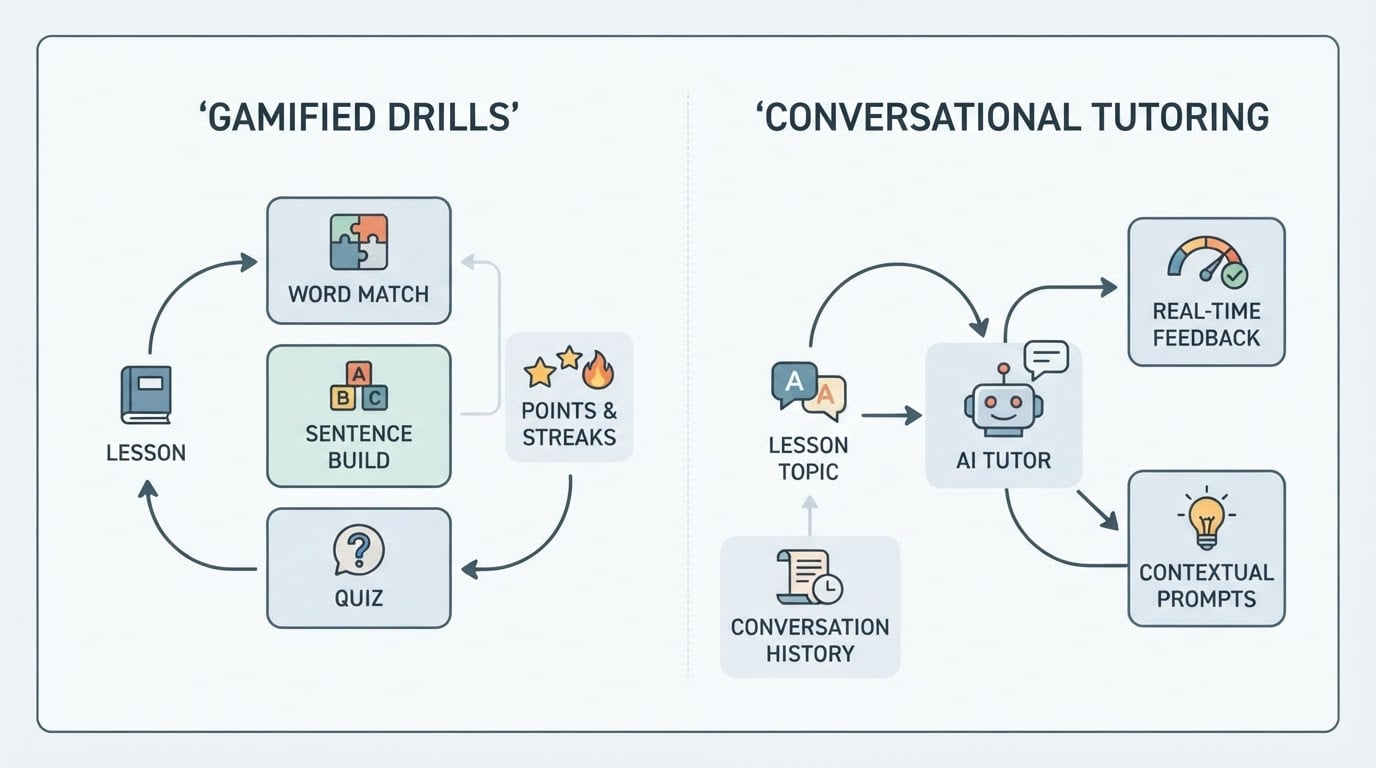
In language education, that usually means:
- prompts that resemble real situations rather than isolated flashcards
- turns of dialogue instead of one-shot quiz items
- explanations that arrive when confusion appears, not only after a score
- difficulty that moves with the learner rather than through a fixed deck
This is not an argument against games. It is an argument against mistaking engagement mechanics for pedagogy. The strongest products will likely keep some of the habit layer. What changes is the core loop: conversation and correction take the front seat; points become optional scaffolding.
Personalized speaking practice at scale
Personalization is one of the most overused words in education technology. In practice, it can mean three very different things.
Path personalization chooses the next lesson or level.
Content personalization swaps examples, topics, or media.
Interaction personalization changes what happens inside a live attempt: the prompt, the wait time, the hint, the follow-up question, the explanation depth.
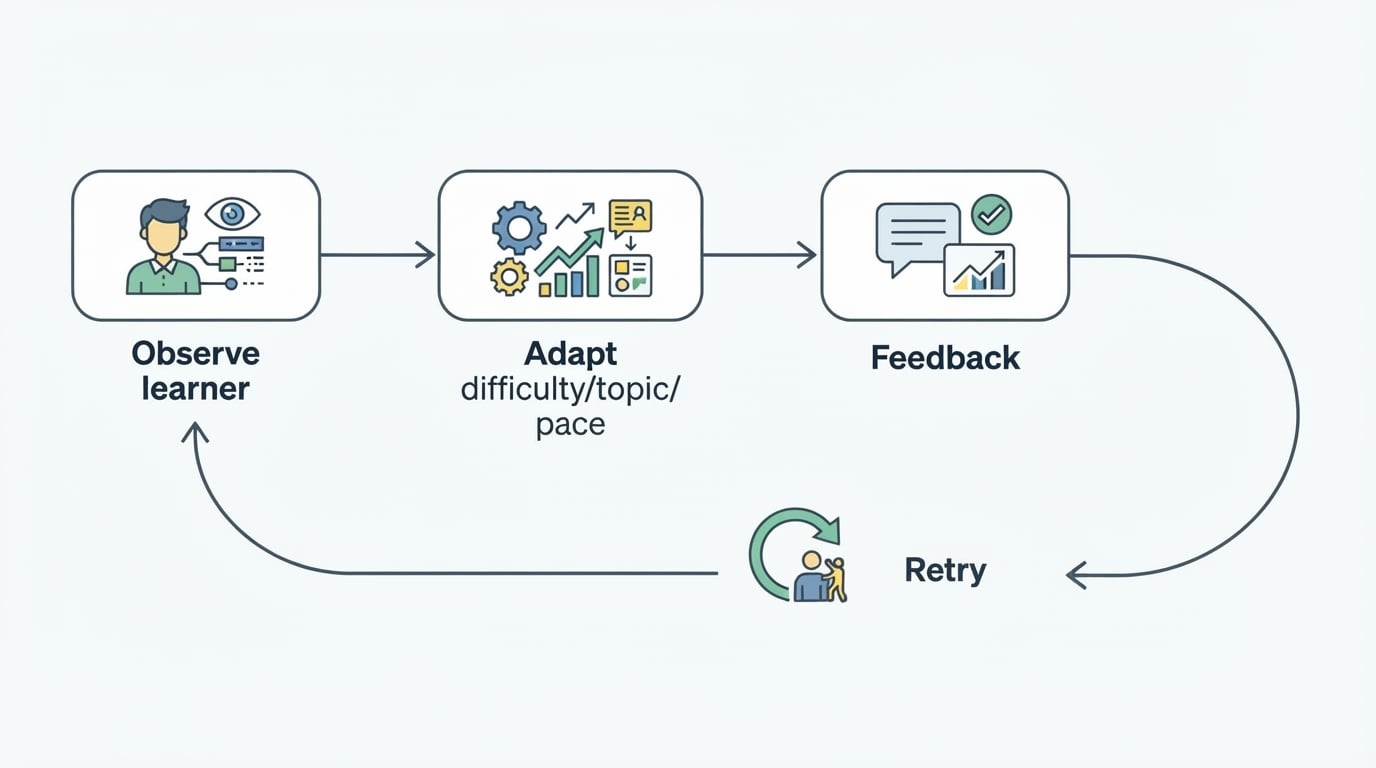
AI is uniquely strong in the third category. A system can notice that a learner understands a structure in writing but collapses when speaking. It can slow down, model a shorter response, ask for a retry, and only then advance. That is closer to tutoring than to content recommendation.
For speaking, scale used to mean recorded drills or peer matching. Both have limits. Recorded drills do not answer back. Peer matching depends on social courage, schedule overlap, and uneven partner quality. AI does not erase those options. It adds a third lane: private, always-available practice with immediate feedback.

That matters for learners who will never book a tutor three times a week. It also matters for classrooms where one teacher cannot give every student enough oral turns. Used well, AI does not replace the teacher. It multiplies the number of attempts a learner can take between human sessions.
UNESCO's public guidance on AI in education is useful here because it frames the opportunity without hype. On its digital education pages, UNESCO notes that AI can support personalized tutoring and smarter lesson planning, while insisting on a human-centred approach grounded in inclusion, equity, and teacher agency. The point is not that machines should own learning. The point is that adaptive support can expand access when people remain in control of goals, judgment, and care.
That framing is especially relevant to language learning. Speaking confidence is unevenly distributed. Some learners grow up with travel, bilingual households, or paid tutors. Others get a textbook and a test. If AI lowers the cost of high-frequency oral practice, it can narrow part of that gap. If it only rewards already-motivated users with prettier streaks, it will not.
What learners can do now that older apps made hard
The practical difference is easiest to see in tasks that used to require another human.
Private rehearsal before public risk. A learner preparing for a job interview, clinic visit, or border conversation can rehearse the full exchange, not just memorize phrases. The value is not a guaranteed score increase. The value is more attempts under realistic pressure before the moment that counts.
In-context explanation. Older apps often separated practice from help. You missed an item, saw the answer, and moved on. Conversational systems can interrupt the flow productively: explain the form, contrast two near-synonyms, then ask you to reuse the corrected version immediately.
Adaptive difficulty inside one session. Instead of finishing a static lesson that was too easy or too hard from the first screen, a learner can stay in the productive struggle zone longer. The session bends around performance rather than forcing performance into a script.
Feedback that targets production, not only recognition. Multiple-choice accuracy is easy to measure and easy to game. Spoken attempts surface different errors: dropped endings, frozen vocabulary, over-literal translation, and avoidance of complex structures. Systems that respond to speech make those patterns visible sooner.
None of this automatically produces fluency. Practice quality still depends on goals, curriculum design, feedback quality, and the learner's willingness to stretch. AI can create conditions that were previously scarce. It cannot turn passive tapping into mastery by itself.
A practical way to evaluate AI language tools
If you are choosing tools as a learner, teacher, or product builder, skip the generic "powered by AI" claim. Evaluate the product against the job it claims to do.
Use this five-part filter:
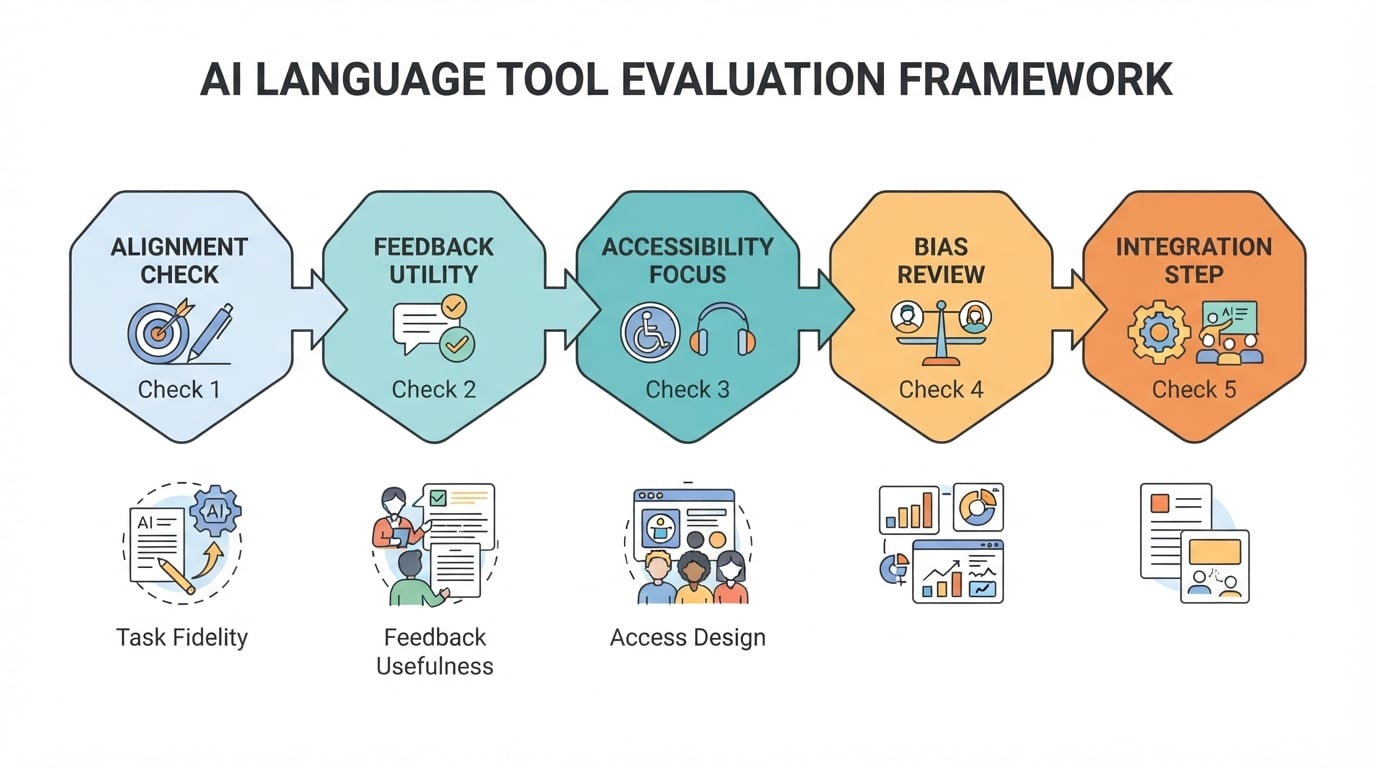
- Task fidelity
Does the core activity resemble the real skill? For speaking goals, look for dialogue, repair, and production under time pressure. For reading goals, look for comprehension and strategy, not only translation. - Feedback usefulness
After an attempt, does the learner know what to change next? A score without a next move is weak feedback. A short model, a targeted prompt, or a retry with a constraint is stronger. - Adaptation depth
Is personalization limited to "recommended lesson 12," or does the system adjust inside the attempt? Path personalization is common. Interaction personalization is rarer and more valuable for tutoring claims. - Human role clarity
Where does the teacher, coach, or learner remain responsible? Tools that position AI as a practice partner tend to age better than tools that imply autonomous mastery. - Access design
Who can actually use the strongest features? If adaptive tutoring is locked behind a paywall that the target learner cannot afford, the educational claim and the product reality diverge.
This filter keeps the conversation honest. It also explains why the market is splitting. Habit apps optimize return visits. Tutor-like systems optimize better attempts. Some products will combine both. Buyers should know which layer they are paying attention to.
Where a concrete product example fits
To make the shift less abstract, consider how beginner-focused language apps are packaging AI today. MANA Learn presents itself as a free, AI-powered language learning app built especially for beginners. Its public positioning emphasizes CEFR-aligned courses from A1 to C2, personalized lesson pacing, short daily sessions of about three minutes, and interactive practice aimed at real-life situations.
That combination is instructive even if you never use the product. It shows the emerging pattern: structure from a recognized proficiency framework, personalization from AI pacing, and practice formats that lean toward conversation rather than pure drill. Whether any single app succeeds depends on execution quality, feedback accuracy, curriculum design, and whether learners actually speak. The strategic direction, though, is clear. The center of value is moving from entertainment wrappers toward adaptive practice support.
For education systems, the same pattern should be judged with UNESCO's caution in mind. Personalized tutoring is promising. It is not automatically equitable, accurate, or pedagogically sound. Human judgment still decides what "good enough feedback" means, which data should never be collected, and when a learner needs a person rather than a model.
The judgment call
AI in education will not be won by the app with the cleverest badge. In language learning especially, the winning designs will be the ones that treat speaking as a skill to be practiced, not a streak to be protected.
That means more conversational attempts, more contingent feedback, and more honest personalization: adaptation that changes the learning moment, not just the home-screen recommendation. Gamification can still help people show up. It should no longer be mistaken for the education itself.
If you evaluate tools through that lens, the noise drops quickly. Ask what the learner can rehearse today that used to require a scarce human partner. Ask whether feedback creates a better next attempt. Ask who remains responsible for goals and judgment. Those questions are tougher than a feature checklist. They are also the ones that separate tutoring from theatre.