The Best Duolingo Alternatives in 2026 (Honest Comparison)
Every few months, someone posts to r/languagelearning: "I've been using Duolingo for two years and I still can't hold a conversation — is there actually something better?" The replies split into the usual camps: Speak devotees, Babbel structuralists, people who swear by tutors. Nobody agrees. That's not because language apps are interchangeable. It's because they solve fundamentally different problems, and most "alternatives" roundups don't explain which problem each app actually addresses.
This guide does. We start with the documented reasons people leave Duolingo in 2026 — not marketing copy — then walk through each major alternative with specific tradeoffs. We built MANA Learn and we're one of the options on this list, so we'll be upfront about where we fit and where we don't.
Why People Actually Search for Duolingo Alternatives in 2026
Understanding the search intent matters here because the alternatives market is full of apps that promise to be "better than Duolingo" without specifying better at what. The evidence points to four distinct frustrations — each requiring a different fix.
1. The Energy System Punishes the Learners Who Need More Practice
In 2025, Duolingo replaced its Hearts mechanic with an energy system. Users start each day with 25 energy units; each lesson costs energy regardless of whether you answered correctly. Android Authority documented the backlash when the change rolled out, and TechIssuestoday tracked ongoing user frustration with the mechanic. The perverse effect: beginners who make more mistakes deplete their energy fastest and get the least practice — exactly backwards from what effective language learning requires.
2. The April 2026 Course Update Broke Learner Continuity
In April 2026, Duolingo pushed a significant course restructuring. Users found themselves dropped into unfamiliar vocabulary mid-curriculum with no preparation. Piunikaweb covered the wave of complaints ; Duolingo acknowledged the problem and added "catch-up lessons." For users who'd built multi-year streaks, the experience of losing their progress context was the final push to look for something else. This is a live frustration — searches for Duolingo alternatives spiked in the weeks following the update, and that intent hasn't fully dissipated.
3. AI Conversation Is Locked Behind $30/Month — and Geo-Restricted
Duolingo's Roleplay and AI conversation features (the capabilities most likely to build actual speaking ability) sit behind Duolingo Max at approximately $30/month . Max is not available in most markets outside the US. For anyone who downloaded Duolingo specifically to build conversational skills, this is the core product disappointment: the app that's free to use doesn't teach you to speak.
4. Gamification Without Language Acquisition
This one is harder to source but shows up consistently in long-term reviews: users who maintain streaks for 12–24 months report feeling fluent in Duolingo but not in the language. The app is optimized for daily retention metrics. That's a valid business goal — and it creates a product that's excellent at keeping you engaged and mediocre at making you fluent.
The Alternatives: Full Comparison Table
App | Best For | Free Tier | AI Speaking | CEFR-Aligned | Languages | Monthly Cost
MANA Learn | Free AI-personalized learning, no energy limits | ✅ Full | ✅ Free | ✅ A1–C2 | 15+ | Free
Speak | Conversational fluency, fast | ❌ Trial only | ✅ Best-in-class (~0.1s) | ❌ | 6 | ~$7–14
Babbel | Grammar-first, structured curriculum | ❌ None | ❌ | ✅ | 14 | ~$7–15
Busuu | CEFR certification + native speaker feedback | ⚠️ Very limited | ❌ | ✅ (to B2) | 12 | ~$6–13
Rosetta Stone | Immersive, no-translation method | ❌ None | ⚠️ TruAccent only | ❌ | 25 | $12–17
LingoDeer | Japanese, Korean, Chinese depth | ⚠️ Limited | ❌ | ⚠️ Partial | 14 | ~$5–15
Duolingo | Gamified habit-building | ✅ (energy-limited) | ⚠️ Max ($30, US-only) | ⚠️ Partial | 40+ | Free / $10–30
App-by-App Breakdown
MANA Learn — Best Free Alternative for AI-Personalized Learning
We make MANA Learn, so take this section with appropriate skepticism — and hold us to the specifics.
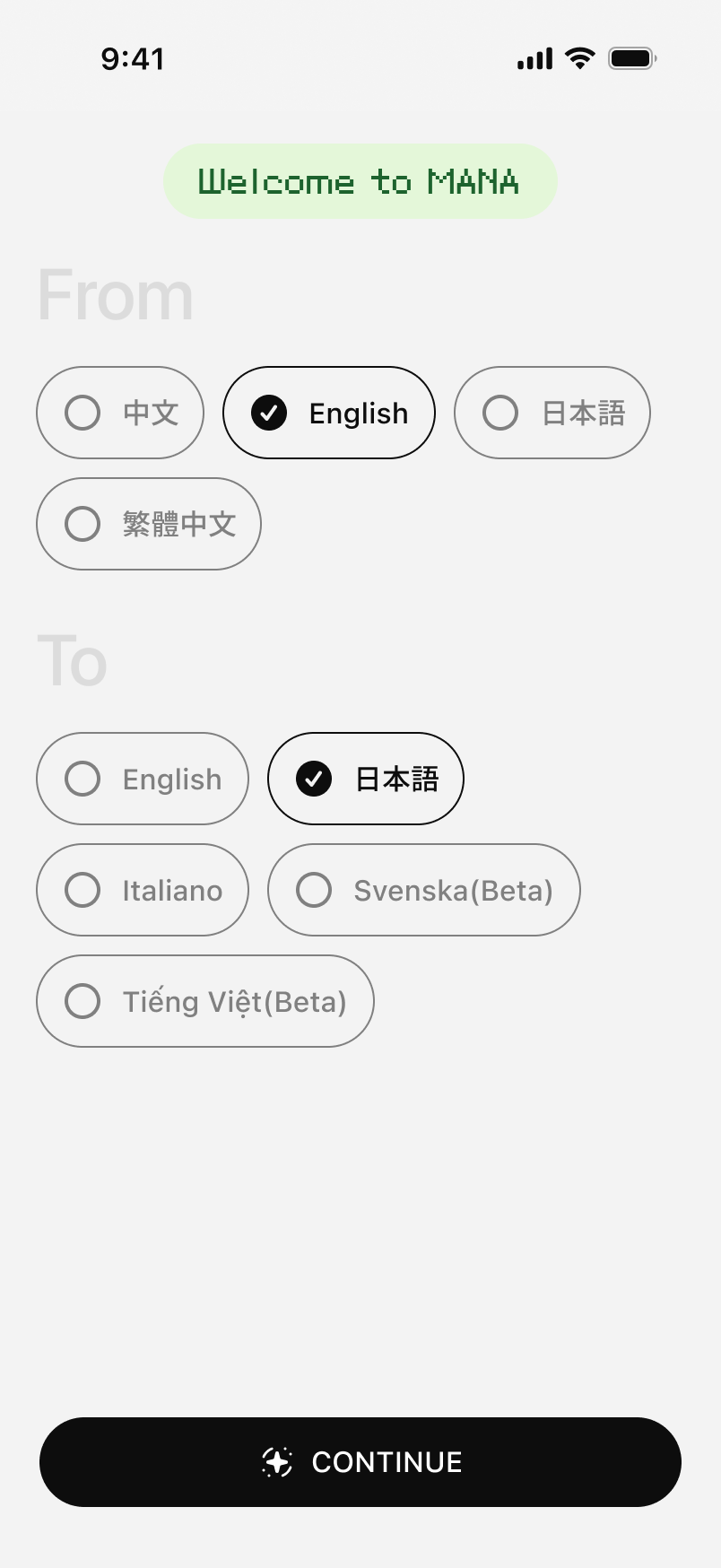
MANA Learn is built by Tokyo Rangers K.K. in Japan. The Tokyo origin matters for one concrete reason: Asian-language learning is our native market, not a localization afterthought. Japanese, Mandarin, and Korean curricula were designed by people who live and work in those language environments — the cultural context and scenario choices reflect it.
What it directly addresses vs. Duolingo:
- No energy system. There's no daily limit on how much you can practice. A beginner who struggles and needs to redo a lesson can redo it without being penalized.
- AI-personalized lessons are free from day one. The system watches your performance in real time and adjusts — no paywall for personalization.
- CEFR A1 through C2. Most apps plateau at B1 or B2. MANA's curriculum is designed to take a learner from absolute zero to advanced proficiency without hitting a content ceiling.
The bundled translation tool. MANA includes a free AI translation tool supporting 15+ languages. The practical benefit for learners: when you encounter vocabulary in the wild, you can translate it immediately and loop it back into study sessions. No competitor bundles an AI tutor and an AI translator in a single free product. Duolingo doesn't offer translation. DeepL and Google Translate don't teach.
What MANA doesn't have yet. We're newer than the incumbents. The app store review volume is smaller than Duolingo's, which means less social proof for skeptical users. If a large community and years of public review history matter to your decision, MANA is earlier in that curve. The product is real and the feature set is functional — but we're not going to pretend we have Duolingo's scale.
Bottom line: If the core frustrations are the energy system and paywalled AI features, MANA solves both for free. If you need community validation at scale before trying something, factor in the newer-product caveat.
Speak — Best for Speaking Fluency Specifically
Speak is the app most consistently recommended by people who tried everything and finally felt like they were actually speaking. The AI conversation response latency is approximately 0.1 seconds — fast enough to feel like a real interaction rather than a query-response cycle. Lingtuitive's 54-day review rated it the top choice for absolute beginners who want conversational ability quickly.
The method is meaningfully different from every app on this list. Speak doesn't teach you phrases — it teaches you to improvise within structures you've learned. That's the mechanism behind real conversation, and it's why users report actually feeling capable of speaking rather than reciting.
Concrete tradeoffs:
- Only 6 languages: English, Spanish, French, Japanese, Korean, Italian.
- Fully paid — a 7-day trial exists, but no ongoing free option. Annual plan is
$84/year ($7/month); monthly is higher. - Speaking only. Reading, writing, and listening development are not in scope. If your goal is well-rounded language ability, Speak covers one quadrant.
- Not suitable for input-first learners or those building vocabulary breadth.
Best for: Learners who've used other apps and still freeze up when it's time to actually talk. Speak's narrow focus is its strength — if speaking confidence is the specific problem, it solves it better than anything else on this list.
Babbel — Best for Grammar-First Adult Learners
Babbel's content is built by professional linguists, not generated or assembled algorithmically. The distinction is real: lessons include explicit grammar instruction, clear sequencing, and explanations of why the language works the way it does — something Duolingo deliberately avoids in favor of pattern absorption.
For users who've spent a year on Duolingo and feel like they've memorized phrases without internalizing grammar, Babbel is the corrective. TodayTesting's Babbel review and icanlearn.com's coverage both note the structured curriculum as the primary differentiator.
Concrete tradeoffs:
- 14 languages, one Asian (Indonesian). If you're learning Japanese, Korean, or Mandarin, Babbel isn't the right tool.
- No free tier. Not even a trial — the first lesson requires payment.
- Content is solid to B1/B2 but shallow past that. Users who reach intermediate level report the curriculum becomes repetitive and doesn't challenge further.
- Plans from ~$7.45/month (annual) to ~$14.95/month (monthly).
Best for: Adult learners of European languages who want comprehension, not just phrase recall.
Busuu — Best for CEFR Certification and Native Speaker Feedback
Busuu's structural differentiator is that actual native speakers of your target language correct your written and spoken exercises. Not AI approximation — human feedback from real speakers. It's also one of the only apps that offers an official CEFR completion certificate, which matters for professional contexts.
Concrete tradeoffs:
- The free tier is functionally unusable for real learning — you can sample but not progress. icanlearn.com's Busuu review documents this clearly.
- Speech recognition is paywalled.
- Curriculum caps at B2. If you're aiming for C1 or C2, Busuu won't get you there.
- User reviews on billing and subscription management flag recurring frustration — guide2fluency.com's coverage notes this pattern.
- Plans from ~$6.08/month (annual) to ~$12.99/month (monthly).
Best for: Learners who need an official CEFR certificate (job applications, school enrollment) or who specifically value real human correction over AI feedback.
Rosetta Stone — Best for Immersive, Translation-Free Learning
Rosetta Stone is the original immersive method: no translations, no explanations in your native language. You learn by associating images and sounds directly with target-language words — the mechanism that underlies child language acquisition. TruAccent speech recognition is among the best available in a consumer app; TodayTesting's Rosetta Stone review gives it specific credit for pronunciation feedback quality.
Concrete tradeoffs:
- Expensive. Three months runs ~$36; a lifetime license is $199. Monthly billing is ~$12–17 depending on plan and promotion.
- The curriculum is linear and non-adaptive. Unlike MANA's AI personalization, Rosetta Stone moves all users through the same sequence regardless of what they already know.
- No grammar explanations. If you get confused about why something works, the product won't help you understand — it just keeps showing you examples.
- Repetition-heavy in ways that can feel mechanical rather than pedagogically intentional.
- 25 languages.
Best for: Learners who've consciously rejected grammar-heavy approaches and want pure immersion — and who've done enough research to know this method fits how they learn.
LingoDeer — Best for Japanese, Korean, and Chinese Specifically
LingoDeer was built specifically for learners of Asian languages, and that focus shows: professional native audio, structured grammar explanations designed for non-Latin scripts, and cultural context that Western apps consistently miss. Japademy's LingoDeer review notes it as the top structured-curriculum app for Japanese beginners.
Concrete tradeoffs:
- Content ceiling around JLPT N4 equivalent. The curriculum ends before reaching intermediate proficiency — users who complete it need to move to another resource.
- Zero speaking practice. The app covers reading, grammar, and vocabulary but doesn't develop speaking ability.
- Plans from ~$5–15/month depending on plan length.
Best for: Asian-language beginners who want structured grammar instruction and professional content quality. Not suitable as a primary resource past the beginner stage.
How to Choose: Decision Framework
Your primary frustration with Duolingo | Best alternative
Energy system / punishment mechanics | MANA Learn (no limits, completely free)
Still can't hold a conversation after months of use | Speak (AI speaking, best-in-class)
Memorizing phrases without understanding grammar | Babbel (linguist-designed structured content)
Need a CEFR certificate or human correction | Busuu (native speaker feedback + CEFR cert)
Want immersion, no translations | Rosetta Stone (TruAccent, 25 languages)
Learning Japanese / Korean / Chinese | MANA Learn or LingoDeer
AI conversation paywalled at $30/mo | MANA Learn (free AI teaching, no paywall)
What to Watch Out For in This Category
A few patterns worth knowing before you commit:
"Free" often means "free to download, paid to actually use." Busuu's free tier is so restricted it barely functions. Babbel has no free tier at all. Speak offers a 7-day trial. When evaluating alternatives, the question isn't whether the app is free — it's whether the free tier offers a real learning path. MANA Learn's free tier is the full product. That's unusual in this market.
Conversation apps and grammar apps solve different problems. Speak is exceptional at speaking. It does nothing for reading, writing, or listening. Babbel is excellent at grammar comprehension. It has no meaningful speaking component. These aren't flaws — they're design choices. The mistake is using a speaking-first app when you need vocabulary depth, or vice versa.
Social proof asymmetry. Duolingo has years of public reviews and a massive user community. Newer entrants like MANA Learn have smaller review pools. A smaller review count doesn't indicate a worse product — it indicates a newer one. Factor in what the reviews say, not just how many there are.
The Bottom Line
The 2026 language app market is more competitive than it's been in years. New apps are reaching top-100 charts; established players are making controversial changes; users are actively reconsidering their defaults.
Most Duolingo alternatives on this list cost money. Speak: $7–14/month. Babbel: $7–15/month. Busuu: $6–13/month. Rosetta Stone: $12–17/month or $199 lifetime. That's a reasonable investment if the app fits how you learn — but it raises the bar for why you'd switch.
MANA Learn is the exception: AI-personalized learning, CEFR A1–C2 coverage, and a built-in AI translation tool — free, with no energy limits and no paywalled features. We're newer than the incumbents and the social proof pool is smaller. But the feature set is real, and the price is zero.
Sources: Android Authority — Duolingo energy backlash · Piunikaweb — April 2026 course update complaints · Duolingo pricing — CheckThat.ai · Speak review — Lingtuitive · Babbel review — TodayTesting · Babbel review — icanlearn.com · Busuu review — icanlearn.com · Rosetta Stone review — TodayTesting · LingoDeer review — Japademy