Best AI Language Learning App Features in 2026
If you've been searching for the right AI language learning app, you've probably noticed something: every app claims to be powered by AI. But the results vary wildly. Some apps use "AI" to mean auto-grading a multiple-choice quiz. Others build a system that actually watches how you learn and changes what it teaches you next.
The difference matters — a lot. And if creators like @DannyIsLearning are any indication, learners aren't fooled anymore. People are actively calling out what they actually want from an AI language app: real conversation practice, pronunciation feedback that catches your mistakes, daily habits that stick, and lessons that move with you — not a fixed script.
Disclosure: This article is published by MANA Learn, a free AI language learning app. The criteria below reflect what our team looked for when designing the product — and what we believe any good AI language app should meet, including ours. We've linked to external research throughout so you can verify the underlying claims independently.
This guide breaks down the four features that define a genuinely useful AI language learning app in 2026, and how to evaluate whether an app is actually delivering them.
Why Most "AI" Language Apps Fall Short
The first wave of AI language apps did one thing well: they made drilling more efficient. Flashcards got smarter. Grammar quizzes adapted to your error rate. That was genuinely useful.
But fluency isn't built on drills alone. Research in second language acquisition (SLA) is consistent on this point: learners need comprehensible input and pushed output — actual production of language under conditions that require accuracy. A 2020 meta-analysis in Language Teaching Research found that output tasks with corrective feedback produce significantly stronger retention than input-only practice. Drills cover input. They rarely cover output with meaningful feedback.
Real language learning requires you to produce language under pressure — to hear a native speaker and respond, to get corrected on pronunciation before a bad habit solidifies, to keep showing up on a Tuesday when motivation is low.
Most apps still treat these as secondary features, bolted on after the core quiz engine. The apps that are actually working in 2026 have flipped that priority.

The 4 Features a Real AI Language Learning App Must Have
1. AI That Adapts to You — Not Just Your Quiz Score
Adaptive learning in most apps means: "You got this wrong, so we'll show it again." That's spaced repetition, not AI teaching. When our team tested several popular apps during MANA's development, we found that most "adaptive" systems only adjusted review frequency — they didn't change content difficulty, lesson type, or explanation style based on where a learner was actually stuck.
A real AI language tutor builds a model of you — your current CEFR level, where you're stalling, which grammar constructions still trip you up — and reshapes the lesson around that model in real time. The goal is that you're never bored (too easy) and never lost (too hard). You stay in the zone where learning actually happens. Cognitive psychologists call this the " zone of proximal development " — work that's challenging but achievable, which is where retention is strongest.
What to look for:
- Does the app place you on a recognized framework like CEFR (A1–C2), so you know where you stand?
- Does lesson difficulty shift within a session, not just between sessions?
- Does the app surface extra practice on weak points without you having to ask?
According to official product information, MANA Learn builds its curriculum around the full CEFR framework — A1 through C2 — with AI that adapts content and pacing based on your individual progress. The full personalization layer is available for free, with no premium tier required to unlock it.
2. AI Conversation Partner That Pushes Back
This is the feature learners are asking for most right now. Not a chatbot that accepts anything you type, but a conversation partner that flags awkward phrasing, corrects unnatural grammar, and pushes you to express yourself more precisely.
The distinction is subtle but important. A passive chatbot lets you coast. An active AI conversation partner creates a low-stakes version of the pressure you'd feel in a real conversation — which is exactly the pressure that forces fluency.
When evaluating this feature:
- Can you have open-ended conversations, not just pre-scripted dialogues?
- Does the app give you feedback on what you said, not just whether your answer matched a template?
- Are the scenarios realistic — travel, work, social interactions — rather than artificial textbook exercises?
MANA Learn's practical scenario learning is built around real-world conversational exercises covering everyday situations: travel, banking, social settings. The focus is on building fluency through interaction, not just vocabulary recognition.

3. Pronunciation Feedback That's Actually Useful
Pronunciation is the feature that most apps skip — because it's technically hard and because it's uncomfortable to tell someone their accent is wrong.
But it's also one of the most requested features in every community discussion about language apps. Learners know that reading and writing in a new language doesn't prepare you to speak it. You need to hear yourself, get corrected, and try again. Without pronunciation feedback, an app is training half of language ability and calling it complete.
What good pronunciation feedback looks like:
- Phoneme-level correction, not just "try again"
- Feedback that's specific enough to act on ("your /r/ in this word is too soft")
- A tone that encourages rather than discourages — pronunciation is humbling, the app should make it safe
This is an area where AI genuinely improves on human tutors for beginners: it's infinitely patient, available at 2am, and gives the same quality feedback on your 50th attempt as your first.
4. A Daily System That Keeps You Showing Up
The research on language learning is consistent: regular short sessions beat occasional long ones. A 2019 study published in Psychological Science on distributed practice found that spacing learning across many short sessions produces significantly better long-term retention than massed practice. A learner who practices 10 minutes every day will outperform one who studies 2 hours every weekend — because language memory requires frequent reinforcement, not marathon input.
The daily system in an AI language app needs two things: it has to be short enough that you'll actually do it on busy days, and it has to be engaging enough that you want to.
This is where gamification, streaks, and session design matter. Not as gimmicks, but as mechanics that solve a real behavioral challenge: keeping language learning integrated into a real life.
MANA Learn is built around 3-minute daily sessions — the lowest time commitment in its category, according to the product's own framing. The gamified format keeps motivation up without pressure, making it easier to maintain the consistency that actually produces results.

How to Evaluate Any AI Language App
When you're comparing options, skip the feature marketing. Ask these questions instead:
Does the app know where you are? A credible AI language learning app will place you on a framework — CEFR is the global standard — so you have a clear picture of your level and what's next. Apps that just start you at "beginner" with no structured progression are guessing.
Does it make you produce language? Reading and listening are passive. Speaking and writing are active. A good AI language app pushes you toward output, not just input consumption.
What happens when you make a mistake? The best apps treat errors as data — they update what you see next and explain what went wrong. The worst apps just mark you incorrect and move on.
Is the free tier actually useful? Many AI language apps use free tiers as marketing funnels, locking every useful feature behind a paywall. Worth checking before you invest time in onboarding.
MANA Learn: Free AI Language Learning, Built Around You
MANA Learn is a completely free AI-powered language learning app designed around the features above. The AI adapts your lessons in real time, the curriculum follows the CEFR framework from A1 to C2, daily sessions run 3 minutes, and practical scenario exercises cover real-world fluency — not just vocabulary recall.
There's no premium tier. Every feature — including full AI personalization — is available to every user for free. No hidden costs, no paywalled curriculum levels.
If you've been looking for an AI language learning app that's built to actually teach you rather than upsell you, it's worth starting there.
Download MANA Learn — free on iOS and Android
Frequently Asked Questions
What is an AI language learning app?
An AI language learning app uses artificial intelligence to personalize lessons, provide real-time feedback, and adapt to your individual progress — rather than delivering a fixed curriculum to every learner. The best apps combine adaptive teaching, conversation practice, and pronunciation feedback in a single experience.
What features should I look for in an AI language app?
Look for: CEFR-aligned level placement, real conversation practice with feedback, pronunciation coaching, and a daily session system short enough to maintain. Apps that only offer adaptive quizzes are missing the most important parts of language acquisition.
Is MANA Learn really free?
Yes. MANA Learn is completely free with no premium tier. Full AI personalization, the complete CEFR curriculum, and all features are available to every user at no cost.
How long does it take to see progress with an AI language app?
Daily consistency matters more than session length. Short daily sessions — even 3–5 minutes — produce better long-term results than occasional intensive study, because language memory requires regular reinforcement.
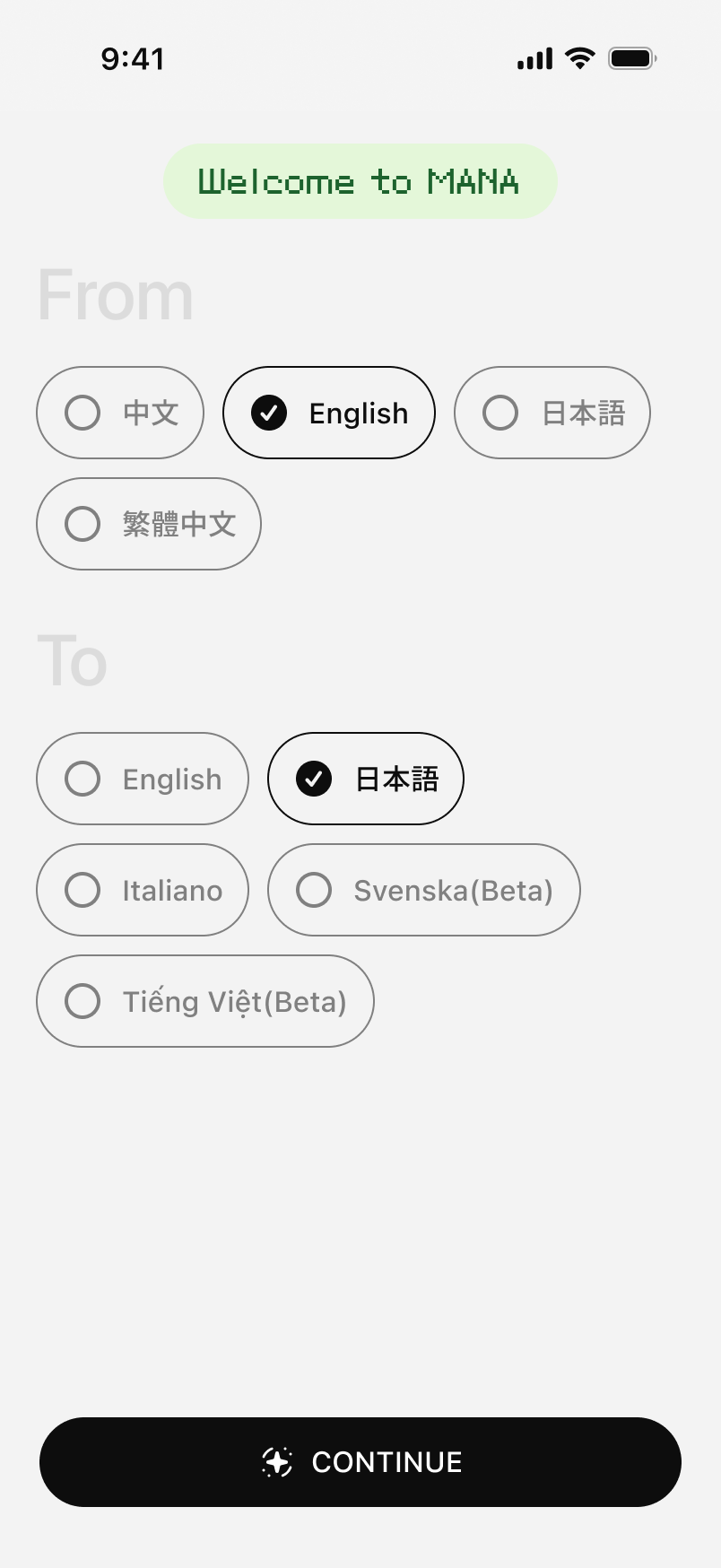
What languages can I learn with MANA Learn?
For current language availability, check the MANA Learn app or the download page directly — the language catalog is updated regularly.
Looking for more language learning tools? MANA also offers a free AI translation tool supporting 16 languages, and a suite of language learning utilities available at no cost.